
Introduction
Canjam London 2025 was a very interesting trip for me this year, as it seemed to be the year where a lot of the audio gear on display was tuned almost perfectly for my semi-basshead preferences. It’s fair to say I came across four in ear monitors that absolutely blew me away in the sub-$1000 category, of which the Sloflo MS001GM was one. I have some previous experience with IEMs manufactured by Sloflo’s parent company (Nippon DICS, who also own audiophile staple brand Pentaconn), as I acquired the interestingly named Pentaconn Scyne Alpha-01 from Canjam the previous year, which is another impressive single dynamic driver design.
Sloflo have been set up as a subsidiary of Nippon DICS, with the origin of the unusual brand name being a portmanteau of “slow” and “flow”, which their website proudly states embodies the concept of returning to the basics, taking time and purely enjoying the music. The aim for the brand is to pursue high fidelity sound and deep immersion for the listener. This is their first IEM, but hopefully not their last.

Acknowledgements
I purchased the the MS001GM from the UK dealer (Elise Audio) for Sloflo with my own money, for a small discount. No input was sought or received from either Elise or Sloflo on the wording or content of this review – all words (however misguided) are 100% my own.
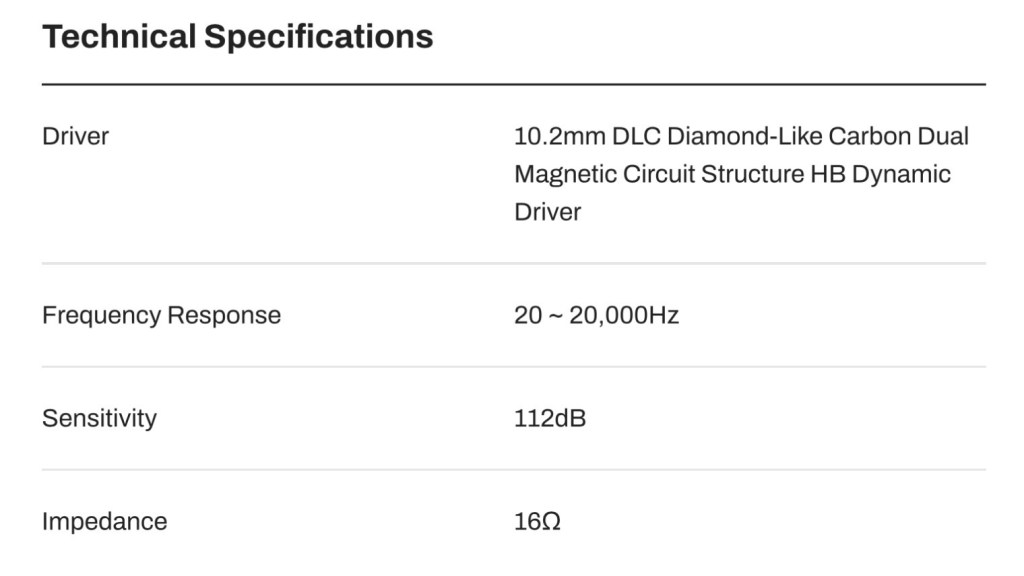
Tech specs
Cost: 379 GBP (at time of writing)
Unboxing
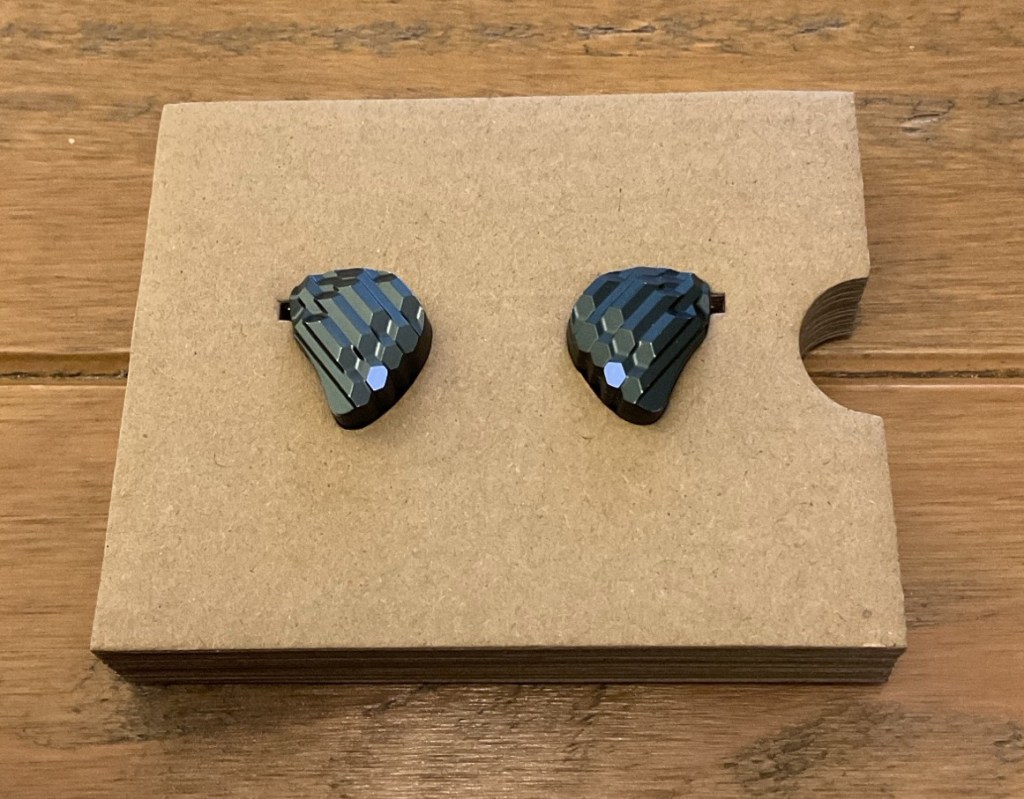
It’s fair to say that the initial impression of the Sloflo MS001GM is pretty minimalist. It arrives in a plain is brown cardboard box not much bigger than the carry case it encloses. The IEMs are presented in a cutout inside the initial cardboard packaging, with the carry case in a separate section underneath. There are no additional visual flourishes involved in the presentation, it’s literally a simple brown cardboard box custom cut to fit the gear.
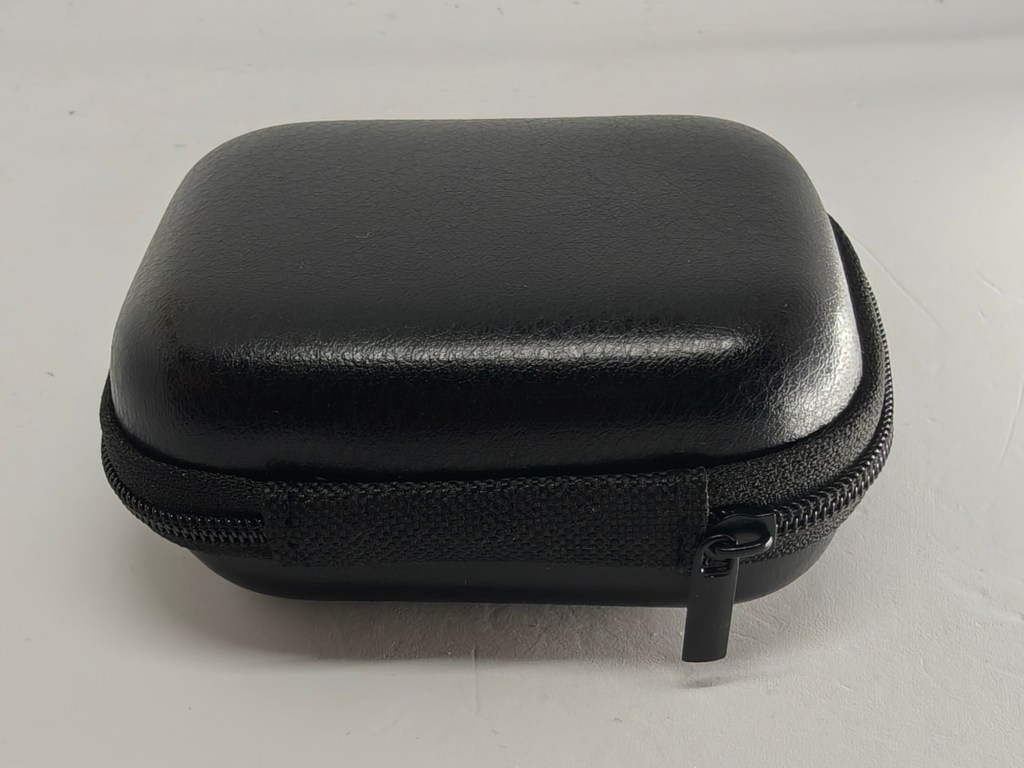
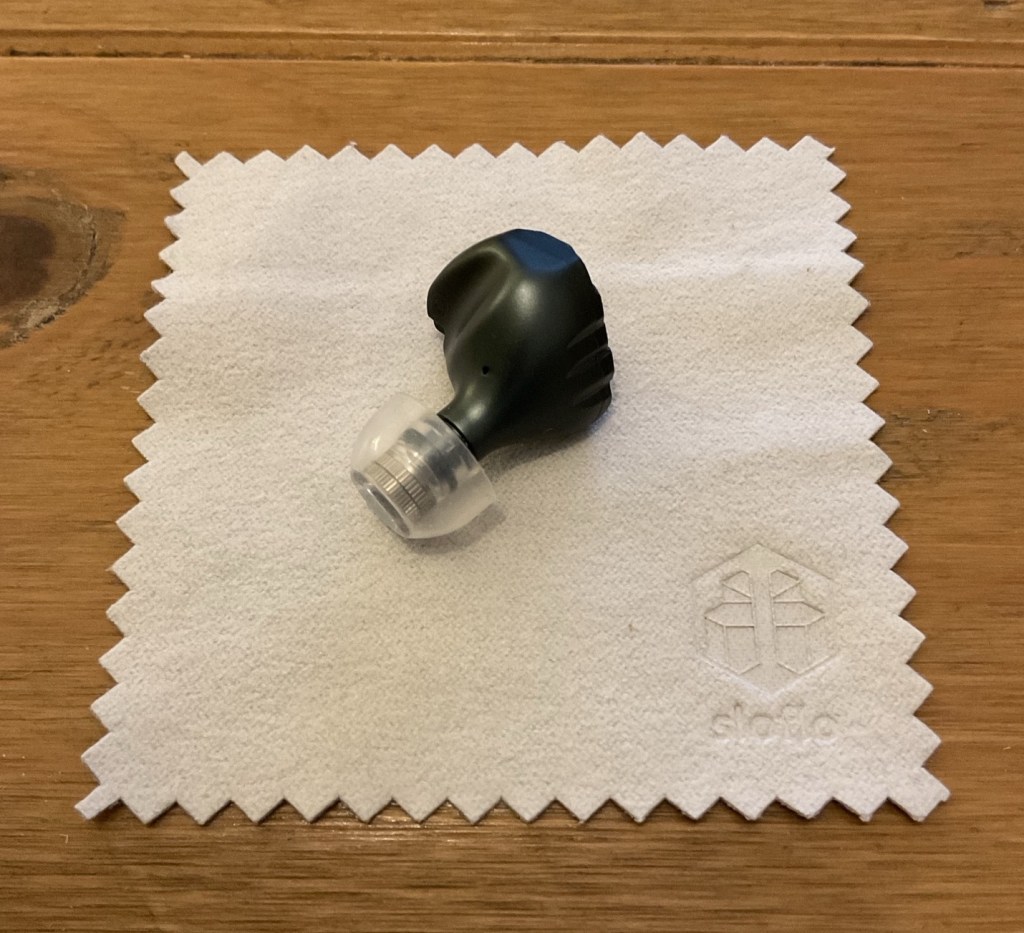
The loadout is similarly minimalist, consisting of a small leatherette style zipped earphone case, 3 sets of silicon tips, two pairs of Pentaconn’s premium Coreir metal-cored tips (in MS and M sizes), a 4.4mm Pentaconn cable, a small cleaning cloth and a warranty card (along with the IEMs themselves, obviously). To be fair, it’s everything you need and both the cable and the included tips are high end, but this is definitely a package that screams efficiency or function over aesthetics or luxury.
Build quality and ergonomics
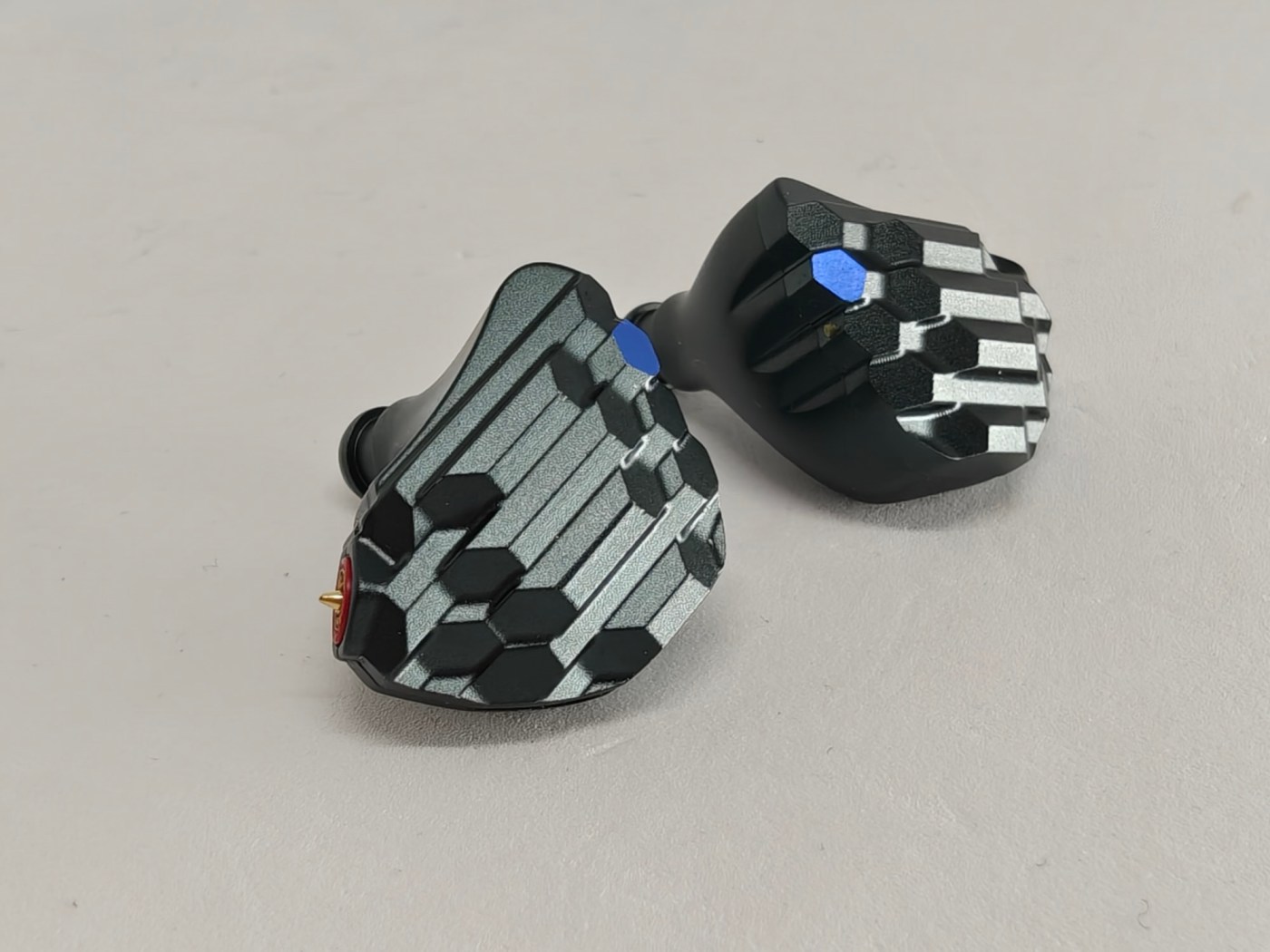
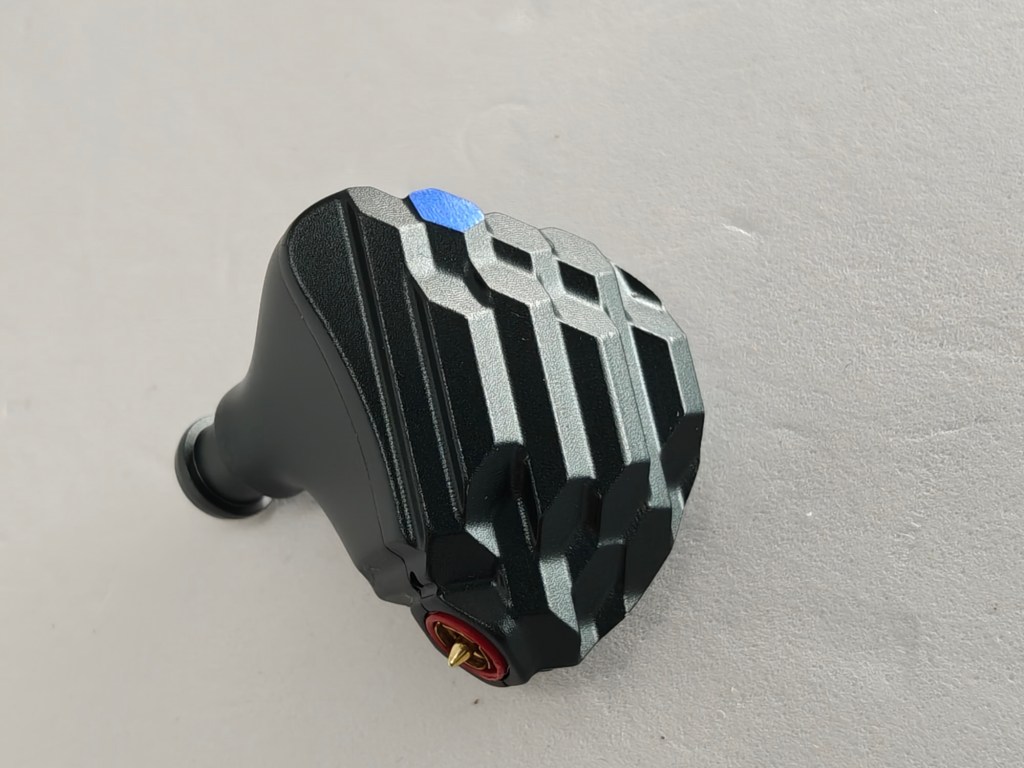
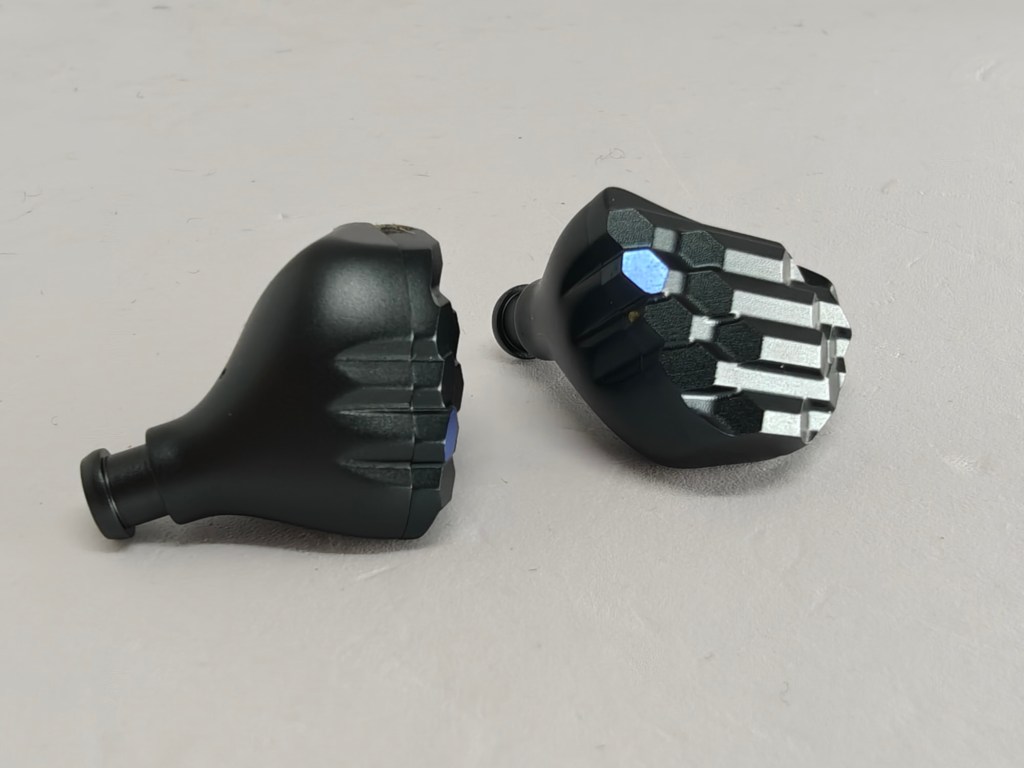
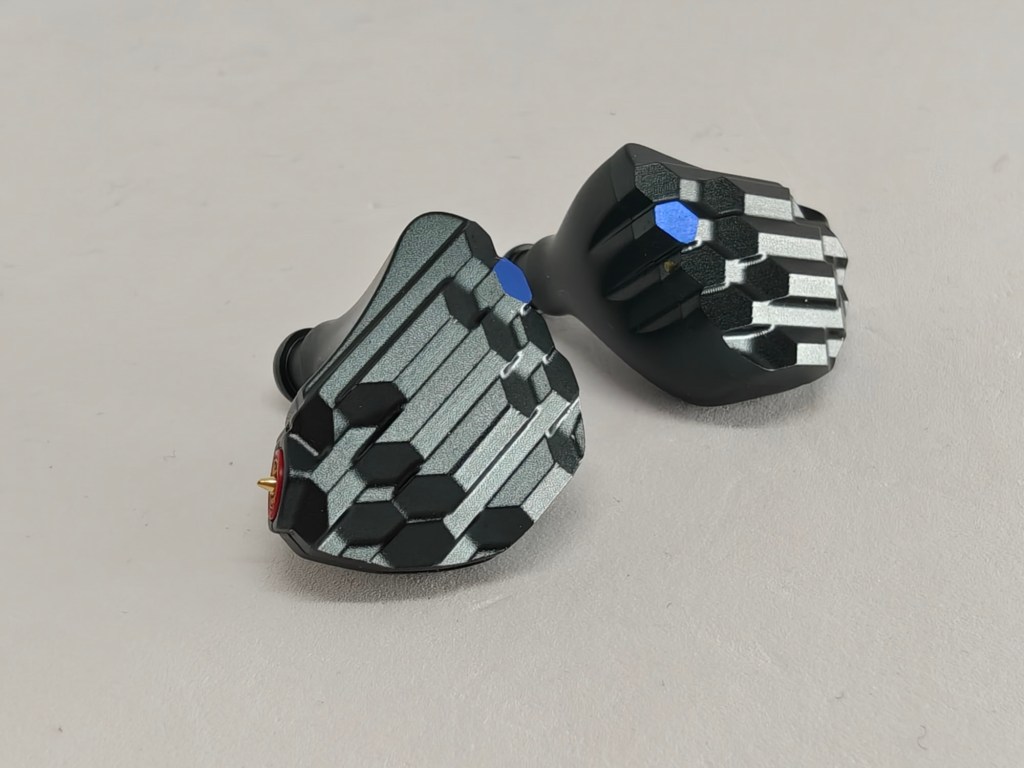
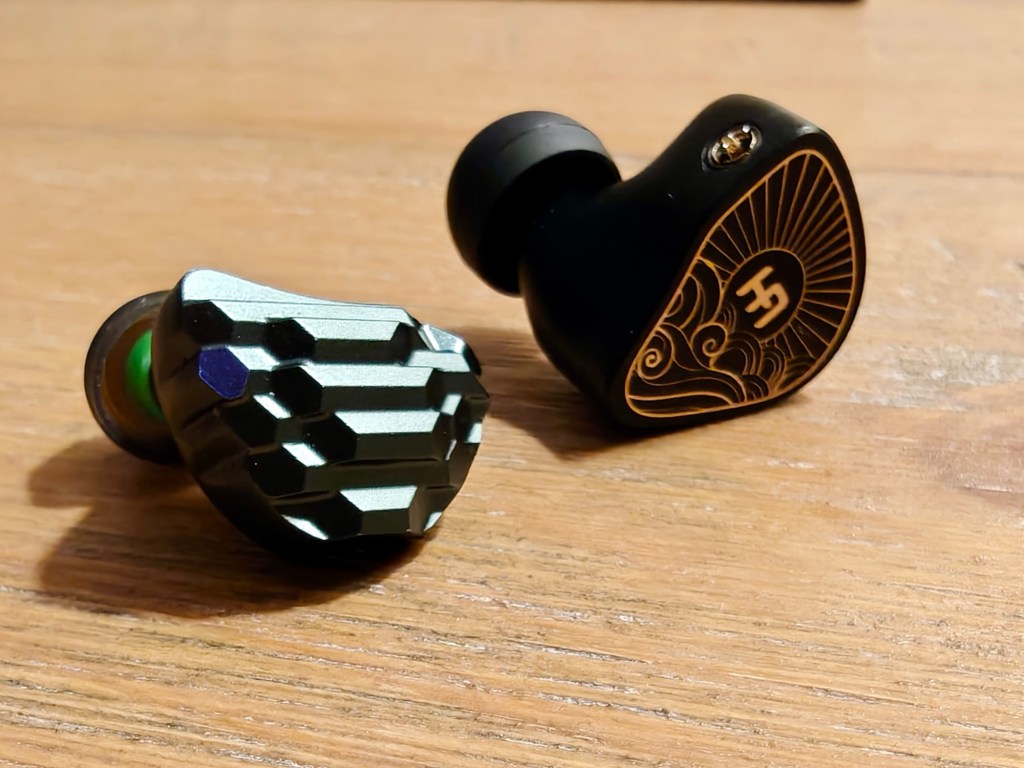
There is no getting away from it, the MS001GM is a beautiful looking piece of gear, if you’re into the industrial design aesthetic. It comes in a solid metal shell, with a 3D faceplate comprised of 8 hexagonal tunes stacked on top of each other in two layers, in a beautiful geometric pattern which looks pretty much unlike any other IEM I have seen to date. There is a nice design touch with the finish of one of the hexagonal end sections, which looks blue in the light, compared to the matte grey anodised finish of the others. It’s a small touch, but does make the faceplate catch your eye as you move it around in the light.
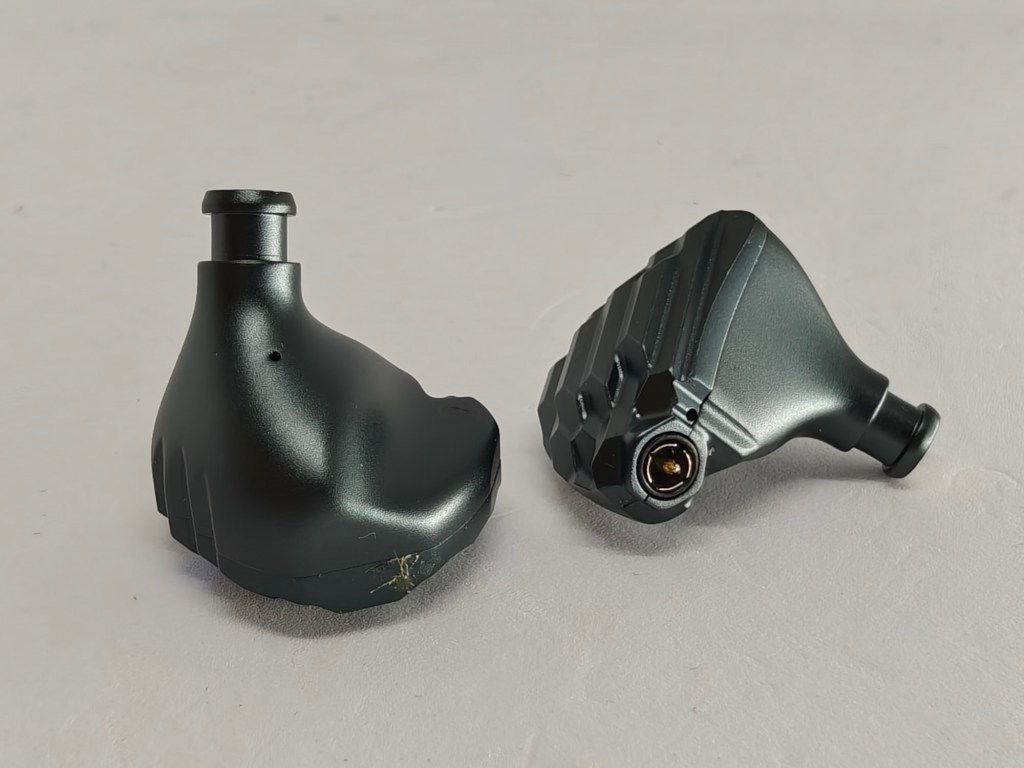
The inner face of the IEM is smooth and low profile, with a nicely ergonomic pseudo-custom shape tapering to a thin, medium length nozzle. With the right tips, you can get a pretty deep insertion with the MS001GM, the IEM shells fitting snugly in the ears and feeling pretty lightweight and very comfortable for long listening sessions. Apart from a small pinhole vent on the inner face of the IEM and a matte grey marking for L and R, there is no other decoration or branding displayed on the shells, Sloflo going for recognition through the unique design rather than a flashy logo on the faceplate.
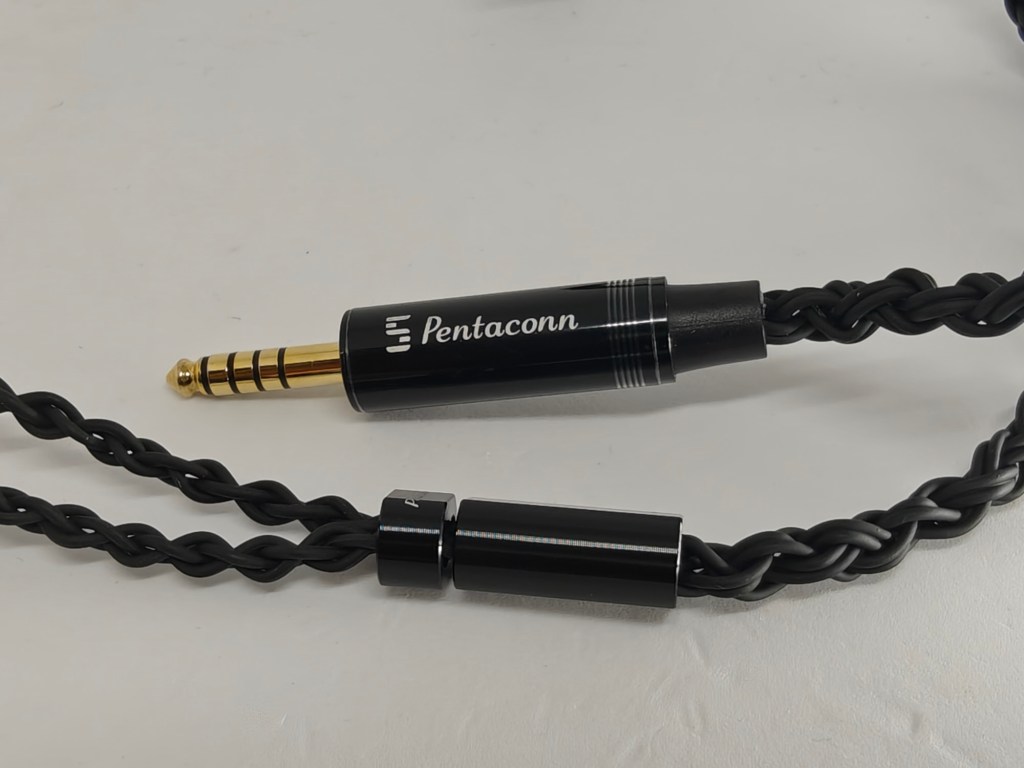
The IEM connectors are of the increasingly popular Pentaconn Ear variety, and connect and disconnect smoothly and snugly. The provided Pentaconn branded cable is definitely a statement piece, made of silver-plated oxygen-free copper with an 8-wire braid and some serious thickness. It’s very supple and pliant in day to day use, with nicely finished connectors and Y-split in jet black to match the black rubberised sheathing on the cable .
The only nitpick I have is with the length of the 4.4mm Pentaconn jack – it’s hardly the most low profile design, sporting almost as much length as an old school 1/4” hi fi plug. It feels solid and sturdy when you’re sat down listening at your desk or around the house, but can prove a little more unwieldy when you are slipping a small DAP into your pocket to listen on the move. It’s not a deal breaker, but given the fantastic ergonomics of the IEMs themselves, a slightly sleeker connector would have definitely been the icing on the cake as far as making the MS001GM your daily driver for out and about use.
As this is a vented DD, it is susceptible to a little wind noise when used in gusty conditions outside, but the bass-boosted signature generally means that isn’t an issue for enjoyment. Overall, this is a unique looking IEM with good ergonomics and a more than decent aftermarket standard cable. A good start.
Initial impressions on sound
Sonically, this definitely doesn’t sound like a $400 IEM. While the Sloflo goes for a more “fun” bass-boosted Xxx style tuning with this IEM as opposed to something strictly neutral or reference, it is definitely not lacking in the technical aspect of music playback, with a nicely detailed and very tight attack and release. There is plenty of sub bass in terms of both quantity and quality, with the Sloflo presenting a voluminous but tight wall of low end with excellent resolution and grip. It’s definitely boosted over neutral, with plenty of mid bass to balance out the sub weight, sloping down slightly from sub to mid for my ears. It’s capable of moving somer serious air on mid bass or sub bass heavy tracks, so should definitely satisfy those listeners with more basshead leanings.
Mids are fairly natural, with zero bleed from the chunky bass underneath. There is plenty of crunch and fine detail in the mix, the Sloflo presenting a fairly middling note weight to keep things nimble enough not to be drowned by the bass but not too lightweight either. The staging is fairly forward with vocals and guitar, with a broad soundstage and good placement of voices and instrumentation. It isn’t the most clinical midrange you’ll hear in this price bracket, but there is just enough of a hint of rawness to go along with the detail to add a nice emotional resonance to singers like Elvis – the occasional raspiness reminds me a lot of the old school Final Audio “emotional” midrange tunings, which is never a bad thing.
Treble is fairly laid back compared to the other ranges but still has plenty of resolution and detailing, presenting clean and clear with a good solidity to notes rather than sparkly or overly bright. It happily cuts through the wall of bass when it needs to, but it isn’t the star of this particular show.
Overall, this is a fun tuning that has an emphasised bass shelf but without sacrificing the quality in the mids or treble. There is a real sense of excitement and energy to this IEM, giving music plenty of oomph and aggression, and laying it all out in a technically impressive manner for the price being charged.
Bass
Diving into the bass, “Heaven” by Emily Sande kicks off with plenty of sub bass hum, with the snare drums cutting through nicely, and Sande’s vocals rendering without too much glare above it all. Sub bass in general is very deep and generous in quantity and quality, with the bass drop after the 3 minute mark on “Why So Serious?” from The Dark Knight OST sounding deep and menacing. The Sloflo also does a good job rendering the fine ticking that kicks in from about 3:35 onwards on ultra resolving gear, making the sounds clearly audible over the background around the 3:39 mark, which is considerably better than some of the higher end IEMs I have tried recently. It captures the grandiosity of this track well, giving the instrumentation some serious bombast and scale in the ear without drowning out the plethora of find details peppered through the background.
Similarly, when spinning up the classical fusion track “Palladio” by Escala, the faint click in the left foreground is clearly audible (if a little muted) around the six second mark against the backdrop of the resonating cellos, which is a good indicator that there is very little if any bass masking going on with the driver here, as that can get easily drowned out on less technical transducers.
The overall theme of the bass is one of control and weight, with the chunky bass guitar on “You’ve Lost That Lovin Feeling” by Elvis Presley and the Royal Philharmonic rendering with a nice roundness and heft, helping to wrap the King’s vocal in a layer of rich syrup without making it sound veiled or chesty. It’s a similar story for “Drift Away” by Dobie Grey, the track presenting with a big chunky midbass and a rich and velvety presentation to the vocal. The track avoids the “whung whung” sort of ice cream bass headache you can occasionally get with this particular song, the midbass showing enough restraint not to overwhelm the rest of the track or assault the ears.
Bass also has plenty of bite and growl, handling “Bad Rain” by Slash with some serious snarl and rasping textures to the bass guitar refrain. I would say the midbass isn’t the most weighty given its low end weighted tuning, sloping a little downwards from the heavier sub bass underpin beneath but still being comfortably north of neutral. The presentation draws a nice line between liquid and dry, with enough slinkiness to handle tracks like “Hello, It’s Me” by Sister Hazel without making the bass guitar sound dehydrated or chalky, but not going full liquid on the roaming bassline either.
Listening to “Acid Eyes” by Scottish troubadour Paolo Nutini is a treat on the MS001GM, with a nice roundness and palpable physicality to the low end that drives the song, but plenty of scale and space for the vocals and other instrumentation to round out the sound. The Sloflo does well at painting in the edges of the bass guitar notes, giving them a real sense of physical presence and resolution.
Going looking for slam and visceral impact, the MS001GM doesn’t disappoint. “Dubai Blues” by rock supergroup Chickenfoot kicks off with a real sense of force to Chad Smith’s drum intro, carefully preserving all the ghost notes on the snare but giving the bass drum and main snare hits a real sense of punch in the ear. This is a driver that moves a good amount of air with each impact, and isn’t shy about showing it. Again, it adds three dimensionality to the drum impacts as well as pure physical slam factor, keeping it both technically and physically impressive, especially for the price tag.
Despite the weight and punchiness, the bass is definitely on the quicker side for a dynamic driver, handling tracks like “Coming Home” by Sons Of Apollo or “Holy Wars” by Megadeth with ease, keeping each drum hit distinct and discretely placed in the ears. The opening drum fill in the former track is particularly enjoyable on the Sloflo, with the grand stage of the IEM spreading the notes like rolling thunder across the back of your skull.
Overall, the bass is very impressive on this set of IEMs. It evokes fond memories of classic basshead sets like the Campfire Audio Vega or Atlas in terms of its combination of power and technicality, bringing a little more clarity into the equation. If you prefer a reference or bass-light low end, don’t like animation and impact from your IEMs, or aren’t used to a really impactful dynamic driver slamming air into your ear canals it might not be for you. On the other hand, if you are looking for a super engaging and muscular low end tuning with plenty of weight, the MS001GM should definitely be on your shortlist. This is the sort of low end that can’t help but bring a big grin to the face every time you listen to it.
Mids
Moving on up to some midrange testers, the Sloflo handles electric guitar well. The notes from tracks like “World On Fire” and “Shadow Life” by Slash are just thick enough to give the song impetus, but not overly heavy or chunky. There’s definitely a decent amount of crunch and bite to the edge of notes, so again, the Sloflo seems to walk that Goldilocks zone of “just right” in terms of the tradeoff between note weight and note definition. The staccato riffing on Shadow Life in particular is very well handled, the dynamic driver showing excellent speed and control to keep a tight grip on proceedings.
Listening to “Beanman” by the wonderfully named UK band Apes, Pigs & Spacemen, the chunky riffs in the early noughties post-grunge track are large and jagged, filling significant portions of the stage either side of the head. The track sounds spiky and full of anima, with the crunchy riffs forming a wall of noise that stops and starts on a sixpence as the track demands. It feels like the aural equivalent of standing in front of a stack of Marshall amps at a rock gig, the Sloflo presenting a large image that isn’t overly thick or syrupy, just big.
Moving further up the midrange, the Sloflo does occasionally flirt with harshness on tracks like “Starlight” by Slash, but it doesn’t quite edge over the line to unpleasantness. It renders the harmonics in this track very enjoyably, injecting just enough energy and spikiness to keep the sound interesting. Singers like Chris Stapleton can sound a little chesty with the Sloflo, but it easily avoids the sibilance in his ballad “Whiskey And You”, presenting vocals with a nice richness to fill in the gaps around the rasp and grit the Sloflo also injects. It throws in the occasional splash of euphony with acoustic guitars, giving the midrange just a little hint of sweetness as well.
Sticking with Stapleton, “Broken Halos” has a subtle to glow to the jangling acoustic refrain, underpinned with some serious punch from the drums. Again, the Sloflo presents the rawness in the vocal without sandpapering it down, but it doesn’t grate or irritate, giving it enough space to breathe a little on the stage and enough substance to avoid sounding thin. Listening to “Millionaire” by the same artist is a guilty pleasure of a track, the slam and punch of the drums contrasting well with the jangle and shimmer of the rest of the track and the intertwining vocal duet.
In terms of timbre, the Sloflo is fairly true to life, embellishing the music ever so slightly to give that “live” tone and energy but sticking pretty close to reality on instruments like piano and strings. “Run” by Leona Lewis sounds grand and sweeping, with Lewis’ powerful vocals fighting above the sweeping orchestral refrain underneath, capturing the breathiness of her vocal in the quieter sections but not shying away from the slight hardness in the recording as it soars upwards. This pushes pretty close to shoutiness in some elements of the track, so if you have a sensitivity for amplified high-mids, this one may cause a little bit of discomfort – personally I find it fine, but as always, preferences and mileage may vary.
The piano tone on “Since You Were Mine” by Smith & Myers is beautifully rendered, with a richness that fills out the simple piano and orchestration into a room filling sound to accompany Brent Smith’s distinctive vocal. There is plenty of inner detail in the piano notes, the dynamic driver of the MS001GM capturing the fine reverb of each piano strike and the subtle intonations of the vocal, which is impressive. It doesn’t shine a spotlight on the micro detail in each track, but if you listen you realise it exposes a lot of sonic information despite the wall of bass and fun it puts out with each track. Impressive stuff.
Treble
Moving up to treble, the Sloflo paints a more laid back but still engaging tuning, with a nice sense of weight to treble notes. It isn’t overly sharp or crispy, leaning more towards a neutral and naturally rounded sort of treble tone. This isn’t the IEM for you if you need a ton of sparkle, but it is definitely isn’t blunted or rolled off in the top end either.
Listening to “Bach Partita In DM” by electric guitar virtuoso Paul Gilbert, the high guitar notes carry a nice level of bite but still feel organic rather than cutting or harsh. Sticking with rockier fare, “Figaro’s Whore” by Sons Of Apollo is another track that feels rounded in the upper end rather than crunchy or harsh – there is plenty of life in the music, but Derek Sherinian’s rambling keys cut through with just enough presence to sound engaging but not enough to irritate.
Leaning into something more laid back, “Chi Mai” by Duel is a heady mix of swirling synthesiser and violin, coming across delicate and sweeping at the same time. The sparkly synth notes that flit around the background feel almost ethereal, with the violin having just enough of a vinegary edge to the notes to cut through the bassier elements of the track as it gets going. Similarly on “Minuet in A Major” by the same artist, the synth and orchestral backing floats through the track in an airy and engaging way. In fact, for an IEM with this level of bass, despite treble notes being the key focus of the tuning there is still plenty of air and space being presented in the upper registers, with the Sloflo extending up into the higher frequencies with no obvious rolloff to my (admittedly not perfect) ears.
Using one of my favourite tracks for treble testing, “Go” by The Chemical Brothers ticks all the boxes, with crisp and realistic hi-hats driving the start of the song, exhibiting a nicely metallic crispness and natural decay. The synth run that arrives just before the chorus sweeps from left to right with vigour, with the Sloflo pulling plenty of smaller treble detail into the ear of the listener over the driving bass line that keeps the song moving.
The IEM does well with electronica in general, handling tracks like “Saturate” and “The Salmon Dance” by the same artist pretty easily, blending powerful bass and the usual array of gritty clicks and textures in the upper end with aplomb, and keeping the cymbal work clean and distinct in the upper end of the soundscape.
As mentioned earlier, this isn’t necessarily an IEM designed for lovers of beautiful crispy or crystalline treble, or who prefer their treble to dominate proceedings. However, if you like your treble a little more rounded and grounded but still technically good and present in a much bassier style of tuning, then Pentaconn have got you covered here.
Soundstage, separation and layering
In terms of stage placement, the Sloflo is quite a forward sounding in-ear. Putting on “Whiskey And You”, the MS001GM pushes Stapleton’s rasping vocal right up against the front of my forehead, so this could get a little grating for listeners who prefer a more laid back or distant sort of sonic presentation. Distant is definitely something the Sloflo isn’t, and it does a very good job of presenting a grand size of note in most tracks, bringing the listener in close to the music and wrapping the oversized notes all around them.
Overall, the Sloflo presents a very big sonic picture, with plenty of note weight and good technicalities. The stage size is large, with the MS001GM throwing instrumentation pretty far out to the left and right on tracks like “Trouble” by Ray Lamontagne, even managing to give this flat track a little depth in the staging too. The presentation is pretty spherical, placing the listener right in the middle of the music next to the singer and pushing out a few inches in each direction from the confines of the skull in all directions.
Separation and layering are both very good considering the bassy nature of the tuning, the Sloflo having no problem peeling apart dense tracks like “Ratio” by Massive Wagons into their constituent parts. There isn’t a huge amount of air between each instrument, but everything is pretty easy to track in the ear.
Listening to something easier on the ear like “Give Me Some Light” by Matt Anderson, each instrument has its own place in the stage, orbiting the head of the listener and giving a nicely panned presentation of the guitar and drums, with Andersen’s smoky vocals sitting front and centre where they should be.

Tip choice
The MS001GM come with some silicone stock tips (sound ok, nothing special) and two pairs of Pentaconn Coreir aluminium cored tips as standard. Unfortunately, the two supplied sizes (M and MS) aren’t quite large enough for my cavernous ears, but I do have a supply of Coreir from my own personal stash in large. Unsurprisingly, the Sloflo plays very nicely with the Coreir, accentuating the staging properties nicely and providing a solid and sticky fit in the ear.
If you prefer a slightly smoother presentation, you can opt for a classic wide bore tip like the JVC Spiral Dots+ or Divinus Velvet, although this does seem to give the stage size a little bit of a hit to my ears. If you want more bass then Final E work well for me, although more bass isn’t something the MS001GM needs by any measure, unless you’re the sort of basshead that likes putting subwoofers in their ear cavities.
My personal preference with these is actually the Tang Sancai Noble ear tips, which are another metal cored tip. They carry the staging benefits of the Coreir, with a comfier fit and a slightly more organic tone to the upper end, so they have hit my personal sweet spot in terms of tuning tweaks for this in-ear. The AZLA Mythril achieve a similar tuning balance with a just a hint more stickiness in the ear due to the composition of the tip, so if a good seal and stability are a priority then these are worth checking out, although you will need to replace them periodically due to the way the sticky silicone will warp and change over time (like the similar Xelastec tips from AZLA).
Power requirements and synergy
This isn’t an IEM that needs a huge amount of power. It runs quite happily at 20-21 on the volume dial in high gain from my Shanling M1S, and 38-39 on Super Gain from my ACRO CA1000, so I could comfortably deafen myself and anyone in a 5 metre radius if I cranked the volume up to max on either source. These will run to ear bleeding volume on pretty much anything outside of a volume-capped Sony DAP, so getting them loud won’t be an issue.
That said, the high spec dynamic driver in the MS001GM seems to respond well to high gain / higher current settings, so if you do have a powerful source, it definitely scales nicely.
Synergy-wise, the IEM is pretty coloured already in the low end, so if you have a source that is already bass-tilted (like the Shanling M1S) it really leans in to the lows. I quite like that for my commuting runs, but when I want to listen at home, I reach for the more neutral and smooth ACRO CA1000 or A&K SE180 to bring out the technical and staging ability of the driver without the extra raucous tint the Shanling gives it.
One pairing that didn’t gel for me was with my MrWalkman modded Sony ZX300, the added warmth and narrow staging of that particular DAP doubling down on some of the existing aspects of the MS001GM and giving it an overly warmed and closed in sound compared to the other options I have on hand.
Comparisons
Hercules Audio Noah (c. $400, hybrid 1xDD 3xBA)
The Noah is a recent release from newcomer Hercules Audio, who have been making waves recently in the TOTL space with their flagship the Moses. The Noah is designed to be a (very) cut down version of that, with a similar tuning ethos, just utilising a smaller driver count hybrid DD and BA setup.
Construction wise, the Noah is another all-metal in ear, with an aluminum shell design. It’s larger in terms of the footprint in the ear, fitting slightly less ergonomically in my ear than the Sloflo due to the bigger shell and smoother contours, requiring a shallower fit. The Sloflo will afford a deeper fit than the Noah, so if deep insertion is your jam, the Sloflo will probably be more to your liking here.
Design wise, the Noah is more traditional, with a flat metal faceplate with a nicely intricate electroplated design on the front. It’s quite classy but fairly low key, in contrast to the MS001GM’s much more in-your-face design. As mentioned in my recent Noah review, both are good looking IEMs to my eyes.
In terms of accessories and loadout, the Sloflo package is considerably more down to earth than the Noah, the simple brown cardboard box and puck style case not really comparing too well to the more elaborate packaging and larger and more luxurious carry case on the Noah.
Both come with aftermarket quality cables (interestingly, both Pentaconn Ear and 4.4mm). The Sloflo cable is thicker and chunkier than the in-house Hercules cable provided (known as the “Ark”, amusingly). The Pentaconn cable has a far chunkier 4.4mm connector, compared to the lower profile and slightly better looking termination on the Hercules model. Both cables are decent, especially for the price bracket, but the Noah’s cable edges it in portability and usability for “out and about” listening compared to the beefier Sloflo model.
Tips are a draw, with Sloflo bundling their Pentaconn Coreir metal-cored tips versus the Divinus Velvets included with the Noah.
Sound wise, these IEMs are superficially similar, both having good weight in the low end and good treble clarity. The Sloflo is the more v-shaped and aggressively tuned of the two, with bass that sits a few dB higher in emphasis than the Noah and a more aggressive treble tuning. The Noah goes for a musical but more W shaped tuning, with a bigger push to bring the vocals up front and centre, and a coloured but more balanced slant. It’s a bassy and rich IEM, but one that still manages to provide a good midrange and treble emphasis where needed. The Noah is a little harder to drive, running at about 8-10 notches more on the ACRO CA1000 to get the same listening level.
Sound wise, the Sloflo definitely has the more pronounced bass, with a noticeably beefier rendition of “Why So Serious?” In the sub lows. Interestingly, the Sloflo also manages to render the faint ticking after the bass drop about the 3:40 mark, with the Noah kicking in a few seconds later to my ears, so the Sloflo competes well in terms of quality as well as quantity. The Noah is comparatively less emphasised in the lower end, although it’s certainly not bass-light (or even neutral).
Mid bass is similarly boosted on the Sloflo compared to the more restrained Noah, providing a more balanced rendition of “You’ve Lost That Lovin’ Feeling” by Elvis and the RPO in contrast to the much bassier version presented by the Sloflo. Again, quality is kept at a premium, with both IEMs showing good resolution and technical bass quality despite the added emphasis of the Sloflo model – which you prefer will come down to how much of a basshead you want to be.
Using the same track to compare vocals, the Sloflo feels more raw and jagged, adding more bite to Elvis’ delivery in comparison to the more velvety rendition on the Noah. The Sloflo is definitely the less euphoric of the two IEMs, giving notes a more crunchy edge and slightly more neutral overall tone through the midrange.
Treble follows the same theme, with the Sloflo having a little more bite and emphasis up top to provide a sharper and more cutting edge to things like violins and cymbals, and an overall more crispy texture in comparison to the more organic and rounded treble tone of the Noah. Tracks like “Figaro’s Whore” definitely have more bite and incisiveness to them, but still aren’t overly sharp, so again it will be preference as to whether you prefer the more aggressive V-shaped leaning of the Sloflo or the more balanced Noah.
Technically, the IEMs are similar, with the Sloflo probably pulling slightly ahead in terms of raw resolution, and presenting a slightly vaster stage, but less holographic than the rendition of the Noah as a result.
Overall, these are two IEMs that are definitely playing well above their price bracket. If you prefer a more musical and balanced rendition of your tunes or are looking for a more impressive package, the Noah is the recommendation here. If you prefer a heavier bass emphasis without losing technicality or prefer your treble spicier, you may lean towards the Sloflo – both are excellent performers in the sub-$1k bracket so there isn‘t a bad choice to be made here.
Pentaconn Scyne Alpha-01 (c. $700, 1 x DD)
The Scyne Alpha-01 (henceforth referred to as the Scyne for the sake of my keyboard and my sanity) is another model made by a Nippon DICS company, this time coming direct from the Pentaconn brand. It is another all metal design, with a solid brass shell in a low profile but pretty unique design, with an electroplated platinum coating.
It is physically a lot smaller than the Sloflo, with a shape somewhere between the classic Westone and Shure in-ear “coffee bean” shape and an Acoustune IEM. Both IEMs are very nice aesthetically, with the Scyne feeling a little more solid and premium in the hand, but losing out just a shade to the Sloflo in terms of comfort despite the small design, purely by the weight and density of the brass shells.
As it’s made by Pentaconn, it unsurprisingly comes with the Pentaconn Ear connectors and 4.4mm termination. The included cable is a lighter weight affair than the Sloflo, with a twisted design sheathed in a smooth transparent rubbery coating. The cable feels a little less high quality than the Sloflo, despite the increased price, and is quite tangle prone, but it does have a far better and more low profile right angled 4.4mm connector, which is rare.
Packaging wise, the Scyne comes in a similar sized box, but it feels more premium, with a much nicer leather style puck case for the in ears, a more comprehensive load out of Pentaconn Coreir tips (4 sizes, as opposed to two on the Sloflo) and a cleaning cloth for the shiny metal shells.
Tuning wise, while both IEMs sport an identical sized 10.2mm dynamic driver and some clever internal venting, the Scyne is a much more “reference” tuned in ear than the Sloflo, leaning pretty neutral but still quite natural as opposed to clinical or sterile. While it isn’t lacking by any means, there is a lot less bass emphasis on the Scyne, with the emphasis firmly on detail and texture with a slightly north of neutral quantity. Resolution wise, both drivers are very capable and resolving, but the Scyne just drapes out a shade more detailing and texture in the lows with its more neutral and less overpowering presentation.
Comparing the mids, vocals are laid a little further back on the stage, and in general the Scyne is positioned a few rows further back across the board compared to the Sloflo, with a less enveloping and wide sound, and more sizzle and edge to mid range instrumentation.
On “Narrow Escape” by Ray Lamontagne, the subtle hi hat and cymbals in the left ear and the soft strumming in the right ear are a shade clearer and cleaner on the Scyne, with the acoustic bass and drums taking up less space on the stage and not competing for the listener’s attention in the ear. The Scyne presents slightly cooler and has the edge in clarity and resolution, although the MS001GM is no slouch here. Lining up “Palladio” by Escala, the Scyne plays back the small click in the left foreground clearer than the Sloflo, with more fine grain and grit in the cello, but trades that off with a crunchier and harsher sheen to the treble as the track kicks into gear. The Sloflo definitely sounds more musical and engaging here, with a grander and more organic sound in comparison to the sharper and more edgy take from the Scyne.
Overall, the treble on the Scyne is more emphasised and a fair amount sharper and more biting than the Sloflo – it flirts on the edge of being too much sometimes, so is the biggest point of differentiation between these two IEMs. If you prefer your treble bright and crystalline with bags of energy, the Scyne is your obvious choice here.
The Sloflo definitely stages larger than the Pentaconn model, with more of a holographic bubble around the head compared to the more intimate presentation of the Scyne.
Overall, these are two very different IEMs that share some common DNA. Both are very capable performers, with the Scyne edging ahead technically with a hair more clarity and resolution and a cleaner overall signature, but losing out on the grandness of sound and the visceral “live” sound that the MS001GM is capable of. If technicality matters and you don’t mind a leaner and brighter take on things, the Scyne is a great shout – if you want to save some cash, or hear a tuning that is still technically excellent in its price range (and the one above) but has some serious bass and musicality baked in, the Sloflo would be my recommendation here.
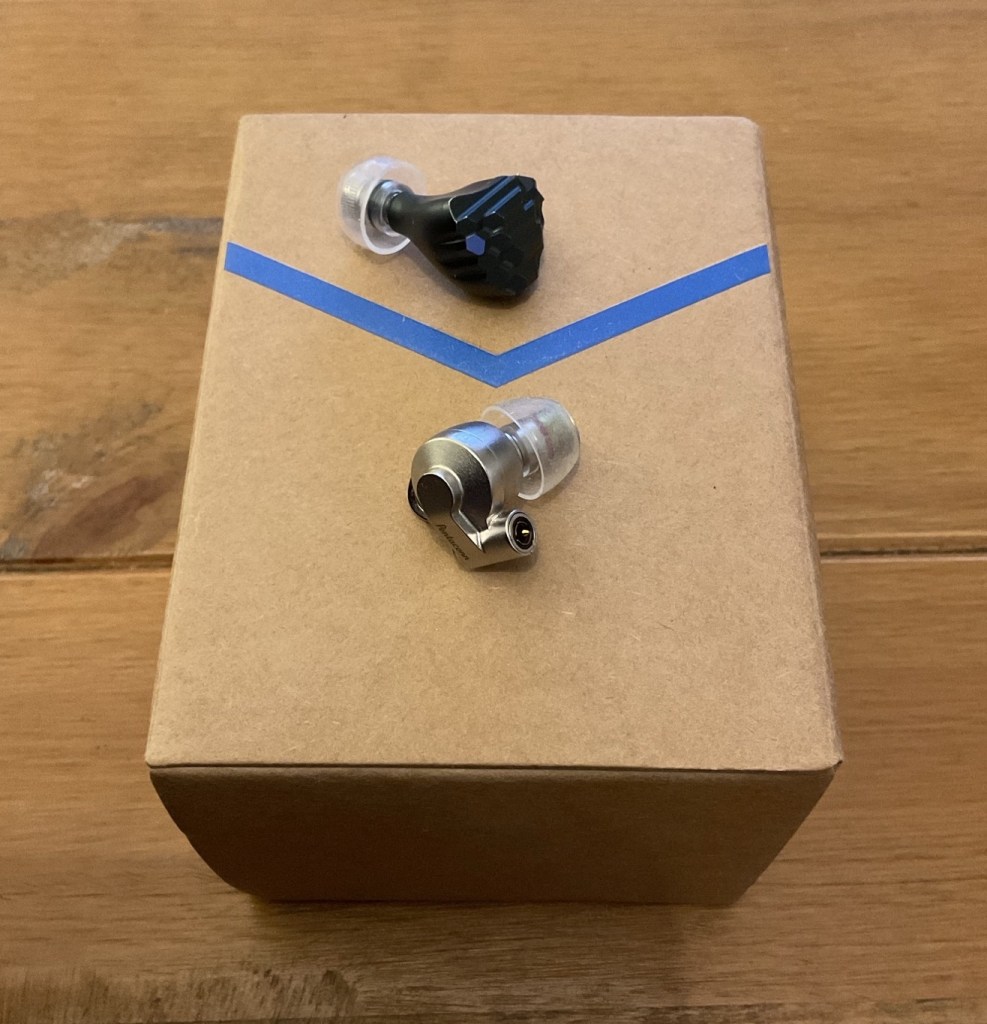
Fatfreq x HBB Deuce (2xDD, c. $200)
The Deuce is a recent collaboration IEM from Singaporean IEM brand Fatfreq, with the emphasis firmly on using their proprietary tech and tuning to push a huge bass shelf into an otherwise balanced sounding in ear. It sits below the Sloflo price-wise, but given the tuning intention, it makes for another good quick comparison.
Starting with the packaging and accessories, there is no competition, with the Sloflo definitely looking like the more expensive of the two offerings even with its own spartan loadout. All the money on the Deuce basically goes to the IEM itself, which is an acrylic affair in a very nicely fitting pseudo custom shape. The IEMs themselves are fairly low profile, with a subtle but appealing faceplate design making it look more like a proper custom IEM. They lock into the ears a little more snugly than the Sloflo, so if long term comfort or stability are key requirements, the Deuce is a good option here.
Tuning wise, both IEMs have a significant bass emphasis, although the Deuce leans further into sub bass, with a truly impressive amount of low end hum. It trades that off with a slightly reduced mid bass quantity compared to the Sloflo, so the Deuce leans more into vibration and weight compared to the more physical slam of the Sloflo.
Listening to something like “Heaven” by Emile Sande will light your ears up with the sub bass on both IEMs, but the Sloflo really pushes more physicality in the punch of the drums and the higher end bass notes, with the Deuce concentrating more energy in the pulse of the ultra-lows as they hum and vibrate through the track. Using “Drift Away” by Dobie Grey as another yardstick, the bass guitar on the Sloflo is rich, textured and huge, with the Deuce presenting a softer and less headache inducing bass, with smoother edges and slightly less overall detail. It’s still big bass by any objective measure, it just loses out slightly to the more impressive (and impressively present) MS001GM here.
Tonally, the Deuce is more laid back and smooth than the energetic Sloflo model. There is a nicely organic tonality to it, leaning darker and less precise than the MS001GM, with a lot less quantity up top. The Deuce isn’t a dull or dark IEM, it just isn’t quite as open or clear sounding as the Sloflo with midrange or upper end intrumentation, the MS001GM pulling a veil off the sound (to coin an old audiophile phrase) and revealing a little more of the fine detail.
Staging is a little smaller on the Deuce, not quite matching the Sloflo’s cavernous sound. Similarly for the other technical aspects like separation and layering, the Deuce is certainly no slouch, but the Sloflo is definitely the more technically proficient of the two IEMs (as you would expect, given the price differential).
Overall, these two IEMs are both basshead dreams, so if you want something more smoky and organic in tone and aren’t bothered about getting that last shade of detail, the Deuce are a very well tuned set. If you want to hear “more” of the track and get that shade more mid bass slam and energy into your listening, the Sloflo is the more technically impressive of the two.
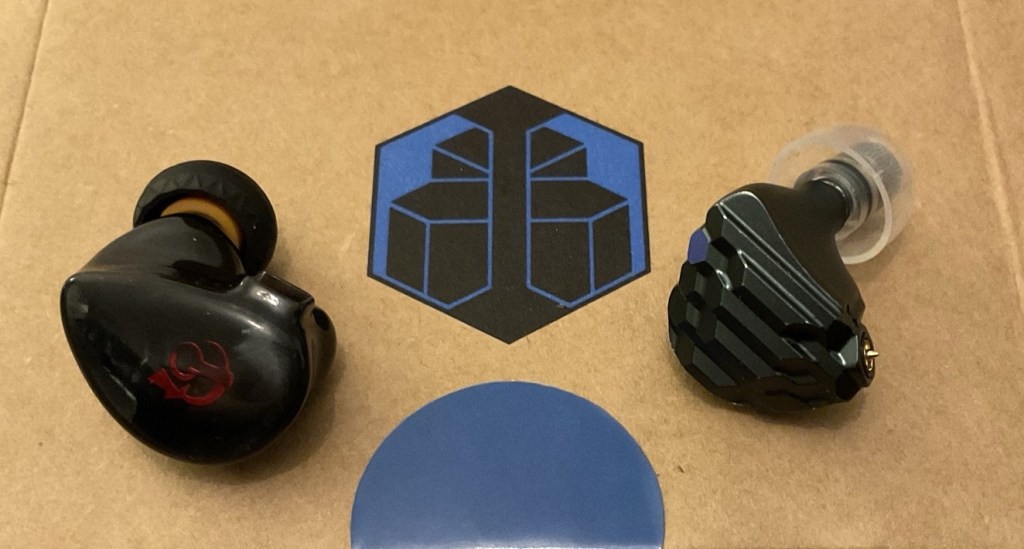
Noble Audio Van Gogh (c. $700, hybrid 1x DD 3 x BA)
The Van Gogh is a recent release from industry heavyweights Noble Audio, with a 4 driver hybrid design anchored around an 8mm Mg-Al dynamic driver for the low end and sporting 3 Knowles and Sonion balanced armatures for everything else.
In terms of design, the Van Gogh is a real looker, with a tiny acrylic shell and a design that is based on one of Van Gogh’s paintings, with beautiful streaks of colour throughout the shells and faceplate. It’s a striking design, and contrasts well against the cyberpunk styling of the Sloflo. The finish of the nozzles (sporting Noble’s crown logo on the actual IEM bore) and the overall standard of finish on the faceplate and included cable are top tier. In terms of accessories, honours are pretty even, with Noble including some of their usual tips, but nothing as high end as the Coreir tips bundled with the Sloflo.
The Van Gogh definitely comes with a more ergonomic and better looking 4.4mm cable, with much lower profile connectors and generally just a more usable feel. The one area where the Van Gogh feels slightly worse in the overall accessory stakes is the case, as it is only bundled with a soft velvet carry bag and cleaning cloth, not an actual IEM case.
Moving on to sound, again these are two similarly tuned IEMs. The Van Gogh goes for a large and unashamedly bassy sound, pushing out plenty of low end through its smaller dynamic driver. It isn’t quite as raucous as the Sloflo, but it’s definitely no slouch. Detail and resolution in the low end is pretty evenly matched, with both IEMs presenting plenty of texture and speed, although the Sloflo does have a slight edge in overall impact and slam factor.
Using “Heaven” as a comparator, both in ears have powerful sub bass, with the Sloflo producing slightly more quantity and visceral hum in the ears. Similarly for mid bass, both have plenty of quantity and ample speed, with the Sloflo hitting just a little harder.
The Van Gogh leans more V-shaped overall, pulling the vocals and midrange instruments a little further back on the stage than the MS001GM. There is a slightly warmer tone to the Van Gogh, with the IEM feeling a little more laid back than the ultra-energetic SLoflo model. Again, resolution is comparable, with the Sloflo keeping up well with the BA driven midrange and upper end of the Van Gogh. There is a richness and weight to the sound of the Van Gogh that takes a little edge off the instruments, presenting plenty of detail but in a different manner to the more up front and aggressive tuning of the Sloflo.
In the treble, the Van Gogh follows a similar vein, giving a rich and present treble that helps bring air to the tuning but isn’t the star of the show. Details here are a little less emphasised than they are on the Sloflo, taking a little more room in the listener’s ear to appear.
In other technical aspects, the Van Gogh differs from the Sloflo slightly. The staging on the Noble IEM is quite intimate, unlike the grander presentation of the Sloflo model. It feels warm and cozy rather than large and impressive, so as always, preference will play a role here. Placement of instruments is good but not great on the Van Gogh, compared to the more precise and accurately defined stage constructed by the MS001GM.
The Van Gogh are an impressively enjoyable offering from Noble, and competing firmly in the same sort of tuning target market as the Sloflo, even if the pricing is somewhat higher. For the extra price you get a warmer and more organic tone and a beautifully built IEM, but in terms of sonics, the difference isn’t that stark. If your preference leans warm and intimate and you need an IEM small enough to disappear in the ear, the Van Gogh is a good call. If you prefer a louder sort of party and want a more up front midrange and a slightly colder overall tone, the Sloflo will nudge ahead. Both excellent, both basshead-friendly – no poor choice here.
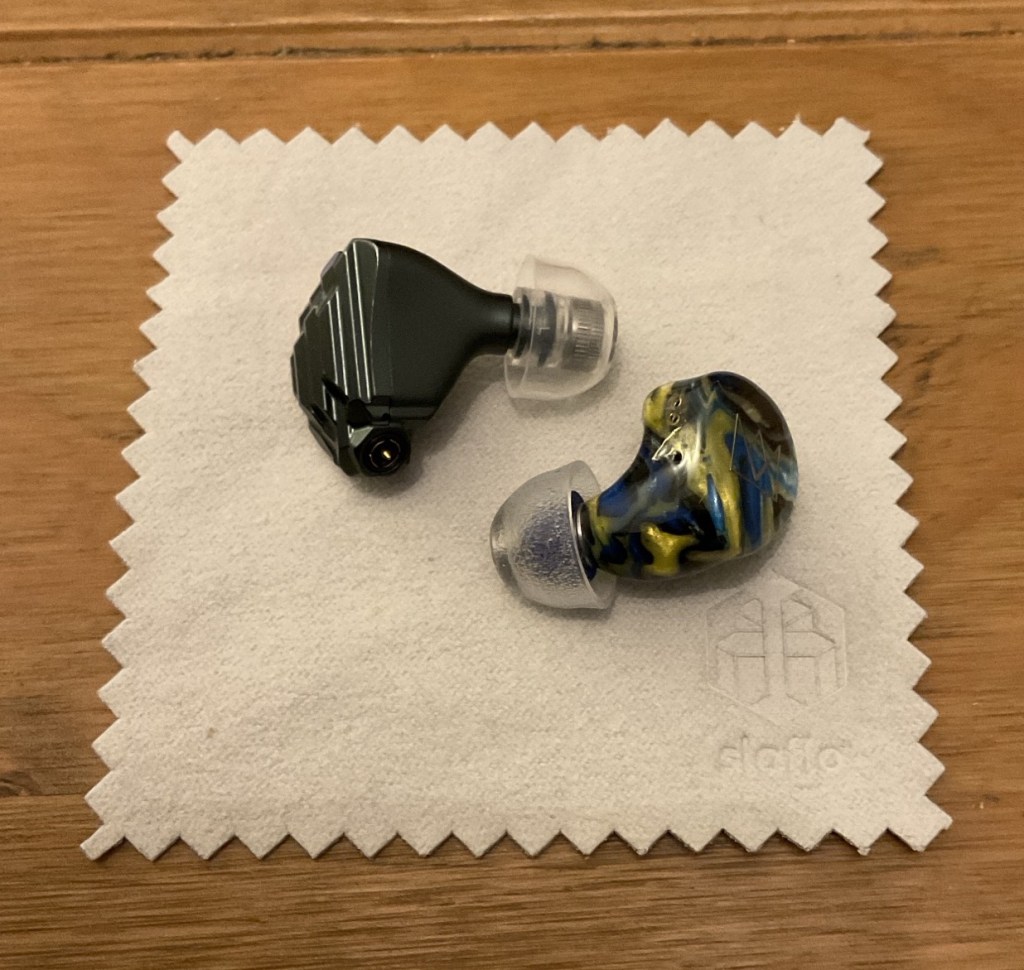
Final thoughts
The Sloflo is an interesting IEM. It’s tuned for musicality, with the proprietary “heavy bass” dynamic driver definitely delivering on that front. It gives plenty of technical capability, with a surprising level of resolution and clarity for what is ostensibloy a “fun” tuned in ear.
It isn’t an easy listening sort of IEM, invoking memories of other classsic bassy dynamics driver flagships of years gone by like the Campfire Audio Vega – this is an IEM that wants to drag you into the middle of the mosh pit or on to the dance floor just as the drop hits, rather than one that wants you to lean back in your comfy chair and melt into the surroundings with some slow jazz. It’s grand, loud but never messy or out of control, with a definitive character that’s is a little different from the sea of Harman tuned models out there right now.
For the price, this is a very competitive technical beast that responds well to better sources but doesn’t need coddling either. Unless you’re seriously low-end allergic or in search of something ultra neutral or bright, this is a serious contender in the sub-$1k marketplace right now, and an absolute steal in the under-$500 space. Hopefully this IEM will get a bit more traction in the wider Head-Fi spaces, as it’s definitely something that needs to be heard (and enjoyed) by more people. A fantastic debut by Sloflo, and hopefully a sign of good things to come from this spin off brand.
 glassmonkey
 jackpot77
 TheOneInYellow
 trekasaurus
 Timothy Cose


 Audio Primate
Leave a comment