


Tech specs
- Technology: Twin Pulse isobaric System
- Driver: 2x 10mm beryllium coated dynamic drivers
- Cable length: 1.2m Litz 392 cores OCC silver-plated + 8cores silver
- Impedance: 16 ohms
- Frequency response: 14-33.000 Hz calibrated on Isophonic curves
- Weight: (without cable) 6 g
- Efficiency: 114 dB@1k HZ, 1mW
- Price: 899 GBP (similar in euros)

Introduction
Spirit Torino are one of those rare breeds in personal audiophilia – an Italian head-fi manufacturer. Given that Italy is stereotypically synonymous with high end fashion (Prada, Gucci etc), automobile design (Ferrari) and even home audio (Sonus Faber), it seems a little incongruous that the home of Stradivarius himself doesn’t have a well known high end manufacture of headphones or in-ear monitors. The team at Spirit (their name literally translates as Spirit of Turin, where the company hails from) are doing their best to change that.
Up until recently, that was through their rather unique designs on over-ear headphones, with an emphasis on technical performance through innovative use of damping and frame design, high flux magnets and isobaric “dual driver” setups. They have finally decided to throw their hat into the ring with in-ear monitors with their first IEM, the Twin Pulse Beryllium.
While the name could probably do with a little jazzing up, it is based on the “Twin Pulse” technology found on their flagship over-ear cans, placing two dynamic drivers running in series in a similar sized driver enclosure to produce a sound that is lower in distortion and a lot faster in terms of the speed of reproduction of transients than a traditional single driver design.

Unboxing
The Twin Pulse come in a box very reminiscent of the larger headphones sold by Spirit Torino, being presented in a white rectangular cardboard box with the Spirit Torino logo and branding printed on the front and a few different stickers on the other sides showing the name of the in-ear monitor, an exploded technical pic of the driver design and a nice pictorial list of the various specs. It’s fairly minimalist but looks quite nice – the stickers give the box a little bit of a “hand-made” sort of vibe, but it looks decent enough.
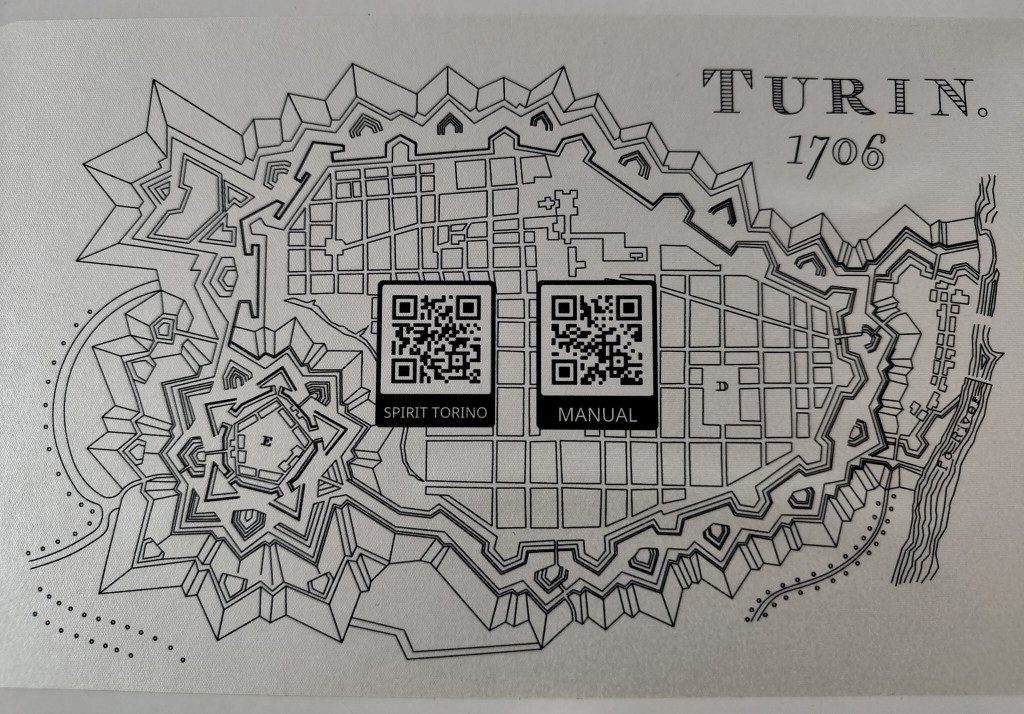
Opening the box, there is a map of Turin city (c. 1706) on the inner lid, along with two QR codes taking you to the IEM manual and the Spirit Torino website respectively. There is another layer to open, overlaid with a black leather-effect coating and a nice rectangular cutout so you can see the embossed Spirit logo on the leather carry case the IEMs are shipped with.
Flipping open this second layer gets you to the actual IEMs themselves. They lay in a foam cutout that takes up the bottom 2/3 of the box, alongside one of the two supplied IEM cables (3.5mm) and a branded metal tip tray that holds the various supplied eartips and two of the three tuning nozzles that the Twin Pulse ships with (the third is obviously affixed to the IEMs themselves.
The IEM case is a very nice rectangular box made out of Italian leather, with a hinged lid and a magnetic closure. It feels (and smells) very nice in the hand, with a subtly embossed Spirit logo on the lid and some red accent stitching all around the edges. Popping open the carry case, you will find a 3.5mm to 6mm adapter, an IEM cleaning tool and a nice fabric drawstring bag (again with the Spirit logo). You will also find the other IEM cable, which is terminated in a 4.4mm balanced connection.
Overall, the unboxing is very nice – the included accessories are high in quality and plentiful enough, and it genuinely feels like a luxurious and well thought-out product design.

Build and design
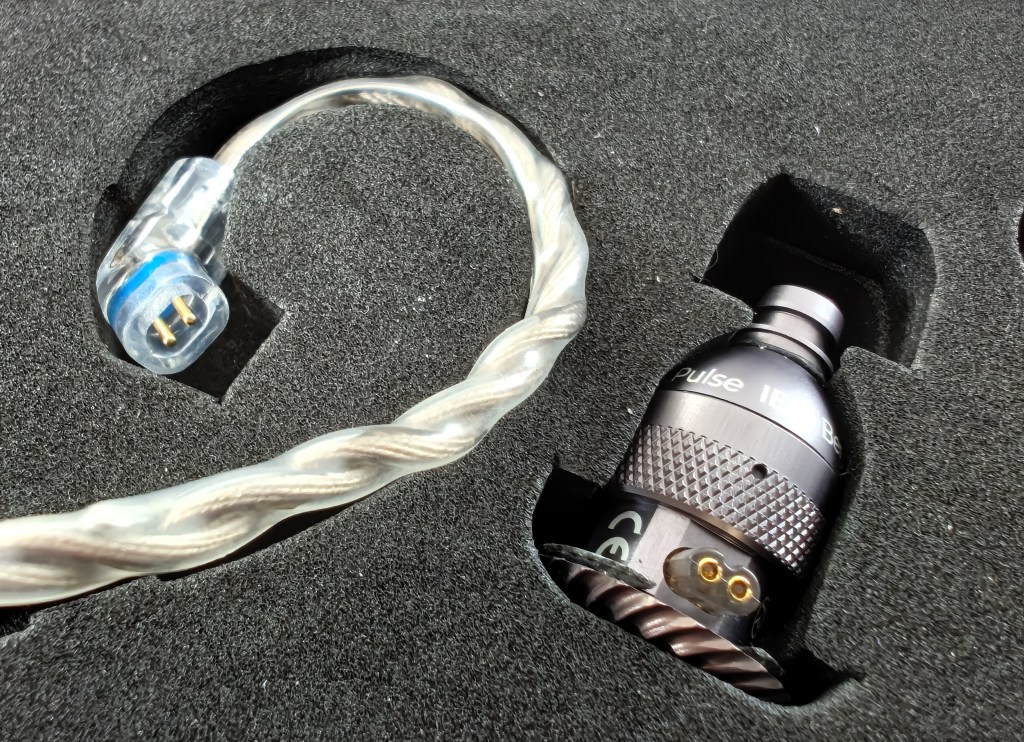
The IEM itself is entirely CNC machined from aluminium, with a pretty unique shell design that looks vaguely reminiscent of a really ornate bullet. Even more unique is the fit – it actually slots into the ear fairly nicely with the correct eartips, but rather than sit flush it is designed to point directly “in” to the ear with the IEM cable mounted almost perpendicular to the barrel, using the QDC style of extruded 2-pin. It’s basically a steampunk riff on the old school Sony XBA-Z5 or EX1000 – pretty eye catching and more than a little unusual compared to the more modern pseudo-custom IEM designs, but it’s comfortable enough once you get the right fit. Foam tips are recommended by the designer to ensure a uniform fit and seal – I’ll comment on that further below, but you will need a tip that seals firmly in the ear to make the most of this rather unique design.
So, to address the rather large African elephant in the room right up front: these IEMs are not the easiest things to wear. I have unusually large ear canals (they match my unusually large head and other oafish extremities) – this usually makes fit a bit of a non issue for most in-ears, but the Twin Pulse are a glorious exception. These things required rolling through almost all the tips I own to find something that keeps them locked tight in my ears and maintain a working seal for any length of time. The included foamies were just a shade too small, and the usual suspects (JVC Spiral Dots, Spinfit, various flavours of AZLA) all managed to work their way out of my ears sooner or later later. I iinally struck gold with the Flare Audio Audiophile foams (an excellent tip with a cone shaped spout), but it did require some effort. If you have normal sized lugholes this may be a non-issue, but just wanted to mention it up front.
In terms of technology, a high-flux neodymium motor drives a twin-diaphragm design, with both dynamic drivers being coated in beryllium and set up in an isobaric design, matching the bigger over-ear Twin Pulse designs. The whole idea is to reduce distortion and improve the transient response of the monitor, giving something with the characteristic physicality of a dynamic driver but the detailing and speed more akin to EST or armature drivers. The IEM is also carefully pressure vented in three different locations on the shell. Ironically, one of those is not the faceplate at the back, which looks semi-open but is actually a solid metal plate in the characteristic Spirit Torino logo design which is used for the internal backplate damping– this is done to better control the driver response, and also to reduce wearing fatigue for longer listening session.
The IEM is a tuneable affair, coming with three different pairs of aluminium “VPS” filters that affect the low end quantity. These act as the nozzle to the Twin Pulse, and can be screwed in and out by hand as required. They are pretty small, so Spirit have thoughtfully added some storage on the metal tip card included so you can keep the other two filters you aren’t using at any given time safely stored away.
The included cables are both “after-market grade”, with an attractive silver-grey colour and carbon fibre inserts on both the IEM connector and y-split. The cable is in a standard braided Litz configuration, consisting of 384 cores of silver-plated OCC copper. Both cables are finished very nicely, and feel premium in the hand, with very low cable memory. They are terminated in a sleeved 0.78mm connector, looking a lot like the standard QDC connection – I don’t know if the polarity is identical, as I don’t have any other QDC-style cables to swap out with, unfortunately. The additional stability the plastic locking sleeve affords is needed given the IEM design, so while this may not be the preferred choice of cable-rollers out there, it definitely makes sense in terms of the overall design here.

Initial impressions on sound
So, what does it sound like? For starters, the tonality is tuneable, with a removable nozzle section that can be swapped out for one of three core tunings – it starts with a natural/neutral take on things based on the Fletcher-Munson curve, then basically tweaks it with bass light, reference and bass-heavy filters. The filters exclusively affect low end response through venting, adding or subtracting around 3dB to slope the signature up or down as required. The initial impressions below are based on the reference filter (for ease of comparison), which is reasonably linear with just a dollop of low end. Spirit Torino tune against isophonic preference curves (basically everything as loud as everything else), so they will never be anemic or overly light in the low end anyway. The aim of that tuning philosophy is to reproduce sound that is “true to life”, with a huge emphasis on timbre, and on musical instruments and voices sounding the same in the ear as they do if you are in the room with them.
The reference filters are quite Goldilocks – not overly bassy, not overly lean. Tracks like “Disc Wars” from the Tron Legacy soundtrack extend low and have a good if not overwhelming sub presence, but definitely enough to capture the dynamic shift and power in the track, which is a collaboration between Daft Punk and an orchestra. The bass can drop low and still remain musical, giving a nicely liquid but deep sounding bassline.
Detail on tracks and little things like the subtle room sounds you hear on some hi-res recordings is so clear on the Twin Pulse it practically screams flagship, which is impressive considering this is pitched at just over the 1,000 euro mark. The Twin Pulse can border on bright and a little tizzy sometimes on more treble-heavy tracks using the reference filter, but this comes with the territory when you capture as much energy in the upper registers. This can easily be attended to by switching to foam tips or the bass VPS filter, if you prefer your upper end on the smoother side.
There is a nice sense of space to the sound up top, sounding suitably clear, and notably wide for an in-ear. It isn’t an IEM that is particularly forgiving – the Twin Pulse has high end resolution and technical capability, but it most likely won’t be one to sandpaper the rough edges off your poorly recorded music. it’s never unpleasant, but definitely not an in ear that will coat everything in sugar and honey when the engineer covered it in broken glass and spikes.

*please note that all sound impressions below are done using the 4.4mm balanced cable, included silicone tips or Flare Audio Audiophile foam tips and the “bass” VPS filter, as this is my preferred configuration.
Bass
With the bass filters in, the Twin Pulse carries a noticeably improved but still not overwhelming amount of bass. I don’t think any Spirit Torino design is ever likely to be considered anaemic, but even in their bassiest configuration, the Twin Pulse still sounds quite controlled. It packs a respectable but not overwhelming rumble in the sub-bass, sloping slightly upwards into the mid-bass before tailing off again to transition pretty cleanly into the midrange. The bass filter definitely tilts this a little more into the “bass-heavy” category, but it still isn’t anywhere near basshead levels of output.
Kicking off with “Heaven” by Emile Sande, the initial intro wobbles the eardrums a little, building a nice sub-bass thrum as the sound winds into gear. It isn’t as dominating as something like the Campfire Audio Atlas or IMR Dark Matter, but there is definitely a sense of physical presence in the sub frequencies. Tastefully north of neutral is how I would describe it – not quite basshead, but definitely packing plenty of body. “Disc Wars” by Daft Punk is atmospheric, with the electronic bass and timpani that underpin the track really sounding powerful now in comparison to the reference filter. There is bags of grip in the low end as well – it doesn’t just provide the physicality, there is also a very technical edge to the bass rendition in terms of clarity and texture. This track pretty much envelops the listener on decent gear, and the Twin Pulse is no exception, surrounding you in a sea of high quality low end noise.
Moving up to the mid-bass, there is a nice amount of quantity to “Get Lucky” by Daft Punk, the Twin Pulse rounding out the bass guitar notes with plenty of depth underneath to complement the fat and juicy funk of the main bass lick. There is a good physical punch to the sound – it isn’t a traditional mid-bass “hump”, but the Twin Pulse definitely isn’t lacking here. Tracks like “You’ve Lost That Loving Feeling” by Elvis and the Royal Philharmonic or “Drift Away” by Dobie Gray both have prominent bass guitars in the mix, and the Twin Pulse pushes the decibels on both without muddying the rest of the sound. Tonality is neither dry or wet, staying fairly neutral, providing bass guitar and other instruments that don’t sound too analytical but also don’t get over-warm or sloppy sounding.
With two beryllium-coated dynamic drivers providing the sound, you would expect a fair bit of physicality down low, and the Twin Pulse doesn’t disappoint. “Bad Rain” by Slash has a nice sense of slam to the opening snare drum lick, and when the guttural bass guitar and bass drum kicks in to gear, you can feel the IEM moving a decent amount of air into your ears. It is very tightly controlled, however – the bass guitar reverb on the bass guitar strings during “Bad Rain” is as clear as I’ve heard it on anything I’ve listened to (including $4k+ uber-flagships), etching out a metric tonne of fine surface detail from the otherwise lithe and supple bass line. Likewise on “Palladio” by Escala, the small click in the foreground at the 20 second mark is ultra-clear and easily distinguished from the rest of the sound, but the Twin Pulse still manages to capture the dynamic shift when the drums and strings really come to life around the 46 second mark and floods the front of the stage with a wall of orchestral noise.
So, its safe to say the Twin Pulse has slam, but the exemplary control and speed of the twin drivers never leaves it get too physical in the ears. I suspect the triple-vented shell may also play a part in that – the chief designer Andrea Rossi did make a point of highlighting the in-ear pressure management of these IEMs, with the intention that they can be worn for many hours by professionals in the studio. It certainly seems to work, but if you are looking for the ultimate basshead experience with an in-ear that slams and vibrates so hard your fillings fall out mid-track, these are probably not the IEM for you. If you want a nicely musical low end with flagship-grade clarity and resolution and a nice grasp of dynamics and texture, the Twin Pulse is probably right up your street.
We can’t finish talking about the bass without mentioning the speed. Putting on something like “Holy Wars” by Megadeth, the frantic drum work resolves crisply into the ear, without a hint of smudge or blurriness, each note starting and stopping on the proverbial sixpence without bending together. Similarly for the pumping bass guitar that tracks the drums, the Twin Pulse does an admirable job of keeping that separate and discernable, which isn’t always the easiest task with 1980’s thrash metal. A core part of the design philosophy behind the use of the twin drivers in an isobaric configuration is to maximise the transient speed of the driver, and it is fair to say that this is an unusually fast driver in general terms, and an extremely fast driver in purely dynamic driver terms. What this means for the listener is that it will keep up with pretty much anything you care to throw at it without getting congested or blurring the edges of the notes, which is a huge bonus in some bass-heavy genres.
Overall, with the red filters equipped, the Twin Pulse is a nicely weighted and very technical listen in the low end for all but the most ardent bass fanatics. For lovers of a more reference tonality then the reference filters will be the way forward, but for everyday listening I have set the red as my default and put the other set back in the IEM box for safe keeping.

Mids
Sliding up into the midrange, the Twin Pulse has a nicely organic tone, with a fairly forward placement and and old school sheen of warmth that evokes some of the Sennheiser HD6xx series of over-ears. The tonality and timbre is very realistic, especially with string instruments and pianos. Despite the twin drivers digging out a lot of detail, there isn’t any artificial sharpness or bite to vocals or guitar, the Twin Pulse relying on the inherent clarity of the design to present information to the user rather than spotlighting it.
Starting with vocals, the Twin Pulse make a beautiful rendition of Chris Stapleton’s gravelly roar on “Whiskey And You”, painting a thick and chesty vocal against the sparse guitar backing, faint echo trails of the recording room echoing off into the background. The usually sandpaper-raw chorus at the 1;46 mark is still pretty caustic, but there is enough weight and heft to the notes to make it pleasant on the ear rather than grating. The Twin Pulse does skirt with the edges of sibilance on this track, but it is mastered pretty hot anyway, so it’s just reflecting what is there with enough polish to make it pleasant rather than altering the fundamental of the track.
Similarly with “Starlight” by Slash, the opening guitar harmonic is raw but palatable, the subtle vibrato and fretting noises of the guitar putting plenty of detail up front. Myles Kennedy’s high pitched falsetto sounds creamy smooth and musical while not losing any of the inherent energy. Guitar tone in general is a real strength of the Twin Pulse, acoustic guitars having a warmth and shimmer that draws the listener in and electric guitars carrying equal measures of bite and substance, giving a genuine physicality to the more chugging rock tracks in my library.
Rockers like “Fill My World” and “Shadow Life” (again by messrs. Slash and Kennedy) are full of body, the stop start riffs hitting with real punch and a fat guitar tone that brings you to the concert hall rather than studio. There is no shortage of texture and detailing around the fringes of the notes, the Twin Pulse striking a nice balance between power and precision in its playback. Much like Holy Wars, the Twin Pulse chew through tracks like “World On Fire” without breaking sweat, keeping each note of the riff clearly audible while still chugging away like Lemmy on a bad vodka hangover.
A recent rediscovery for me when looking at how an in ear renders tone and detail in the midrange is the track “Slash and Burn” by the legendary Welsh band Manic Street Preachers. The guitar tone starts bright and bouncy, then ramps up into an almost cartoonish mixture of fuzz and grunge, sounding like someone mashed up Weezer with early-80s Metallica. Again, the Twin Pulse pulls it all together, giving the bouncy riff the initial burst of sunny energy, then pulling the fuzzy chug in the left and right channels up enough for the listener to clearly differentiate between each layer in the “wall of sound” mixing of the track. Now, this is a track that pushes the borders of brightness on most gear once the guitars really start squealing around the 150-second mark, and the Twin Pulse doesn’t avoid that, staying true enough to the mix to sail this particular track pretty close to the sun if you’re not a fan of high mid/lower treble peakiness.
Vocals are well served by the Twin Pulse, giving a lifelike timbre and slight sweetness to the rendering of both male and female vocals that fills out the notes nicely. There is a richness and warmth to vocals that plays well with most rock and acoustic genres – the vocals aren’t placed artificially close to the listener, sitting in the middle of the stage with just a slight emphasis to pull them clear of the surrounding instrumentation. Listening to something like “Shallow” by Bradley Cooper and Lady Gaga is an intimate and evocative experience, capturing the live ambience of the recording and the contrasting tones of their voices well.
Piano tracks also shine with the tuning of the Twin Pulse, capturing that pervasive sense of sonic “realism” that these IEMs do so well. “Run” by Leona Lewis contrasts the warm piano notes, the swelling strings behind and Lewis’ ultra-pure soprano into a mesmerising (and far superior) version of the original Snow Patrol dirge. Again, while not hugely sonically similar, the thought crosses my mind about the best of the HD6xx range or some of JH Audio’s more vocal-centric IEMs in terms of the rich and organic nature of the instruments and voices. It’s not the crispest or most bitingly energetic midrange you will hear, but there is detail aplenty if you listen, and the genuine weight you feel behind the notes is definitely a worthwhile trade off for some of that all-BA urgency you get with armature designs. If you like your mids even handed and erring on the sweet and slightly rich side, you won’t be disappointed here.

Treble
Moving on up to the higher frequencies, the Twin Pulse transitions seamlessly, with no huge emphasis on any particular element of the high end. In keeping with the rest of the frequency spectrum, treble is slightly warm in tone, without any artificial sparkle. That isn’t to say the Twin Pulse is a dark or dull in-ear, though. There is a nice element of bite to high notes on violins or other string instruments, and synthesisers shimmer where they need to.
Starting with “Duel” by classical fusion quartet Bond, the bubbling electronic noises have the required fizz, and the violin sounds very lifelike and quite prominent in the mix, carrying just enough vinegary bite and edge not to sound smoothed over in the mix. Similarly for “Quixote”, violin sounds rich and resonant where it needs to, and thin and almost biting when it doesn’t, but always with that beautiful tone.
Switching to something more synthetic, “We Found Love” by Calvin Harris is a relentlessly bright track on most gear, and the Twin Pulse doesn’t disappoint here. Ditto “Written In The Stars” by Tinie Tempah, the Twin Pulse playing off the pulsing synths against the simple kick drum beat underneath.
Sticking to electronica, “Saturate” by The Chemical Brothers is suitably glitchy and scratchy in the high end (it’s recorded that way), with plenty of detail in the subtle noises that populate the top part of the audio. Cymbals sound lifelike, if a little less stylised than some IEMs I own can make them sound. The speed of the dual-driver setup is apparent here, with the Twin Pulse rendering a very high level of detail into the background of the track.
“Go” by the same artist has plenty of zip in the upper end, with the driving hi-hats sounding crisp in the upper right of the soundstage. The Twin Pulse actually renders more apparent subtlety and detail to each cymbal strike than I’m used to on other gear, which is a nice surprise – you can almost imagine the drum-sticks hitting the cymbal on each click. The sweeping synth that dominates the chorus of this track is well rendered here, coming in from a decent distance outside the left ear and swooshing round the back of the listener’s head before existing out of the right. It adds enough froth to the mix to keep the track bubbling along nicely, with some nice spatial effects dotted around in the back for good measure.
Overall, treble sounds smooth and full bodied, with very good detail retrieval and a decent sense of energy – it isn’t the most forward or aggressive, but it isn’t something I would describe as relaxed either. The overall tone is reminiscent of good EST treble from a modern tri-brid in ear, with good extension up into the hypersonic / room sound area of frequency response but a more bodied and clear tone rather than anything remotely hot or crystalline. In the context of the rest of the sound, it works very well, sitting in the Goldilocks zone of “just enough” to keep the rest of the sound honest. It won’t blow your hair back in terms of quantity if you are an avid treble-head, but it won’t shy away and darken your favourite tracks either. Very well judged for my personal tastes.

Soundstage, separation and layering
The Twin Pulse has a decent stage size, pushing a little out of the ears in both directions once you get the tips and fit right. It isn’t massive or cavernous, painting a more realistic stage size, in keeping with the approach to tone and timbre – realism over dazzle-dazzle. Where the Twin Pulse really does excel is with the imaging, however. This is an IEM that is chock-full of sonic information when it comes to where your sounds are coming from on the stage. Live tracks (like the previously mentioned “Shallow”) give a real sense of the stage space they were recorded on, and tracks that were receorded live in the studio like “Better Man” (by Leon Bridges) really nail the instruments and singers down to a tangible spot in the stage. This is top tier stuff, aided by the fact that there are no phase or coherency issues given the fact it’s effectively one driver producing the output with two diaphragms.
Layering and separation are also highly impressive given the more “normal” staging dimensions of the sound. The clarity and quick transient response ensure that every note has its own particular space in the sound, with enough black space around it to clearly focus in on if you want to listen critically. It isn’t the sort of laser separation you get with some IEMs or DAPs that dissect the music, leaving it connected enough to enjoy but still separate enough to appreciate all the subtle nuances. “Trouble” by Ray Lamontagne bears that statement out – the kick drum and snare shuffles away in the far left of the stage, the bass plunks lazily outside my right ear and Mr Lamontagne and his guitar sit front and centre of the stage.
This track also identifies something else the Twin Pulse is good at: height. The imaging of the instruments is somewhere a little north of medium, but there is a definite sense of height to the vocal and violins in this track, with the cymbals sitting on top of the sound. Height isn’t really something I notice with a lot of my gear, until I listen to the Twin Pulse for a while and realise that it probably should be more present in some of the other IEMs I use.
Putting all this together, you get a stage size that is somewhere between oval and spherical, flirting with that much overused audiophile term “holographic”. In part this depends on the DAP and track you are listening to, though – the Twin Pulse doesn’t artificially inject any additional stage to electronic tracks, so if something has been recorded flat, it will remain that way on playback. If you put a well recorded live album on (like Joe Bonamassa’s Carnegie Hall discs), the tracks really come to life.

Power requirements and synergy
Simply put, you can drive the Twin Pulse from most things, but you really should use something that packs a respectable amount of current and wattage. This is an IEM that is very true to the source in almost all aspects, so will soak up plenty of additional power without batting an eyelid if you have a source that can really take a grip of the sound. This is the definition of an IEM that sounds good with most things, but will scale with your stack.
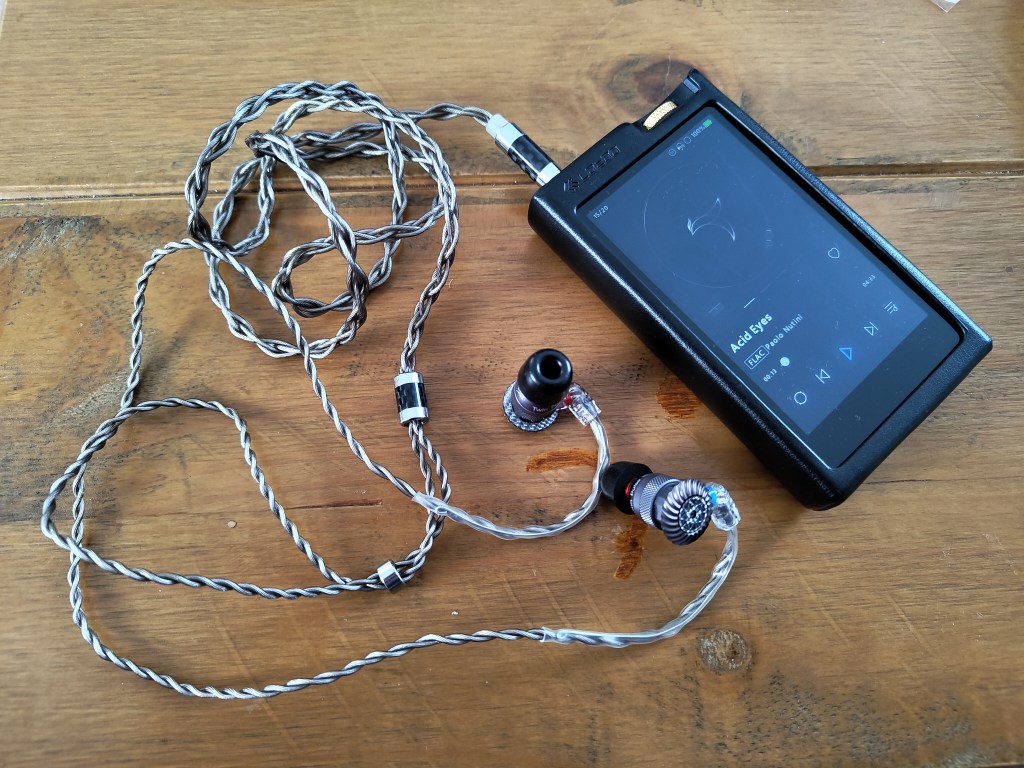
Playing it from my smaller Sony DAPs (modded A55 and stock A305) sound decent, but you get the feeling the performance is being bottlenecked by the DAP somewhat (once you know what the Twin Pulse are fully capable of). The Hiby R5 Gen2 through the Class A outputs sounds good, but hooking it up to a Lotoo PAW 6000 or Astell & Kern SE180 (SEM4) and you really start to hear some noticeable improvements in placement, control and raw detail retrieval. In the same vein, you don’t need to be using a desktop grade setup, but it does also play exceptionally well out of my small SMSL HO100 amp setup too.
Synergy wise, as mentioned this is a pretty transparent IEM. It does have a slightly warmth, so if you want to double down (my preferred option) then something like an AKM Velvet dac will really bring out the body to the sound. My current favourite is the SE180 with SEM4 fitted, as I think this slightly warm and musical DAP brings the best aspects of the Twin Pulse fully to the fore. It sounds more clinical from the PAW6K (in keeping with the more neutral tuning of that player), but just lacks that final bit of “soul” that the IEM normally outputs for my tastes.
Tip choice
This is normally the bit where I suggest my preferred tips and what works best, but I genuinely think this will depend almost entirely on the wearer’s ear anatomy. If you have normal shaped lugholes, sticking to the manufacturer recommended foamies is probably a safe bet. If you don’t get lucky with those, anything that usually helps keep the tips firmly locked in the ear and sealed will be your best bet. The IEM design doesn’t provide much in the way of assistance for maintaining IEM insertion or seal, so it’s almost entirely dependent on the tips you use wanting to remain in your ears.
Just to clarify, I did use my usual go-to AZLA Xelastecs, but annoyingly my ears are too big for this IEM to take advantage of the normal deep insertion I get with these, so they stopped sealing well after a few uses. Users with normal shaped ears probably won’t have these issues, so as always, your mileage may vary.

Comparisons
IMR Acoustics Dark Matter – c. 700GBP at launch, 1xDD 1xDD “conduction motor”
The Dark Matter is one of the limited edition “Pro” models released by boutique IEM manufacturer IMR Acoustics a few years ago. It sits in a roughly similar price bracket to the Twin Pulse, and is also built around a 2xDD core. In this case, the Dark Matter used one 10mm ADLC dynamic driver for full range sound, and a smaller 6mm ADLC dynamic driver as a “conduction motor”, running it full range as well but coupling it tightly to the IEM shell in an attempt to get a similar effect to the more commonplace Sonion bone conduction motors. It sports a similarly all-metal design, and a similar loadout of carry case, multiple tips and cables. The overall look and feel of the IMR package is a lot more utilitarian than the beautiful presentation of the Spirit Torino model, but still packs in enough accessories (like 3 differently terminated cables) to compete in the appropriate price bracket.
Sonically, the IEMs share a few similarities. For a start they are both tuneable via detachable tuning nozzles, although the Dark Matter nozzles are ore plentiful (8 in total compared to 3 from the Spirit IEM) and also have a detachable filter tip, giving them a total of 40 different tuning permutations. In practice that is total overkill, but it is nice to be able to manually EQ your IEMs to such an extent rather than relying on PEQ or other electronic tuning methods if you want a different sound.
Starting with bass, the Dark Matter are an unapologetically basshead set of in ears, pushing out serious low end. using my preferred filter setup on the Dark Matter (black base, blue tip), the DM push a few dB more bass than the Twin Pulse at the same volume. DM bass is fairly even handed, presenting plenty of both mid and sub bass, with the Spirit Torino having more of a mid bass “thumb” and less sub bass comparatively. Both IEMs provide a lot of detail and texture in the lows, but the Spirit Torino just shades it in terms of overall clarity.
Surprisingly, the Twin Pulse also shades the low end dynamics, providing a shade more slam to kick drum notes in comparison to the slower but weightier thud of the Dark Matter. In terms of quantity without sacrificing quality, the DM will take some beating, but if you like your bass present but tight and detailed as well as thick then you will probably lean toward the Twin Pulse. The DM would be the choice if you listened to a lot of sub-heavy tunes, and need that absolute “wall of bass” type sound you can only get with a real basshead in ear.
The mids are good on both, but subjectively a little more prominent on the Twin Pulse, and definitely slightly clearer, with more obvious resolution. The Dark Matter is capable of decent clarity, but it’s only when you compare directly to the exceptional resolution (for the price bracket) of the Twin Pulse that you can clearly hear the difference. For an IEM with a large bass shelf, the DM manages to keep bleed out of the mids, but overall there is a similar weight and tonality to both so all else being equal, the Twin Pulse provides the “better” midrange to my ears.
Treble tells a similar story, with the Twin Pulse having more treble, presented more clearly. Again, the DM isn’t lacking or technically blunt, it just can’t quite compete with the dual-DD setup of the Spirit Torino model in terms of the sense of space and air, and the overall clarity here.
Staging is a draw – the DM has a very large soundstage with big note size, expanding out around the head. Imaging is also very good. Where the Twin Pulse pulls ahead is in the height and depth, with the DM presenting a wider but less deep sound, with slightly less of a holographic feel to it. The DM is deeply immersive, so stageheads will definitely appreciate the tuning here, but the Twin Pulse is just able to tie a few of the other technical aspects here together slightly better, so unless width and note size are your absolute priority, the Twin Pulse just edges ahead here.
In terms of ergonomics and general usability, the Dark Matter is an emphatic win. The DM shells are fairly small and shaped like a hockey puck, with an angled nozzle that means they insert nice and deep into the ears and sit pretty snug and flat. They just slide in and stay put, which is a whole heap less effort than the Twin Pulse setup. Despite being significantly vented with two vents on the side of the shell, they also isolate an order of magnitude better than the Twin Pulse, especially with the right tips. If wearing comfort, ease of use or sound blocking are your key considerations, the Dm are an easy recommendation in this category.
Finally, on the subject of power, the Dark Matter are considerably easier to drive then the Twin Pulse, and while they do scale nicely with higher end setups that can pump more current and voltage, they definitely aren’t as source-transparent as the Twin Pulse.
Overall, these are two IEMs for slightly different uses. The Dark Matter is excellent as an out-and-about in ear, packing bombastic bass and a nicely sweet midrange and treble – it isolates well, and provides a great on the go solution for bassheads. If you prefer to do your listening sat in a chair or at home and you need something with maximum technical ability to go along with a musical bass, then the Twin Pulse is the easy rec here. Both are great IEMs, but I woudn’t use the Spirit IEM for my daily commute, and I wouldn’t listen to the DM at home.
Final thoughts
As a first offering into the in-ear market, the Twin Pulse definitely stands out from the crowd. The packaging and overall presentation is well thought out and luxurious, and their unusual steam-punk looks are definitely eye-catching. Much like their over-ear line, Spirit Torino have bucked conventional wisdom when it comes to ergonomics and wearing comfort, and in the main they have pulled it off, with a few caveats: the fit is finicky, and the unusual side-mounting mean that these are not an IEM you can wear around the place unless you want to be adjusting the seal every 30 seconds or so – strictly sedentary listening only.
That choice would probably be more significant if the Twin Pulse didn’t sound so enjoyable. The clarity and realism of the playback is just perfect for drifting into your music collection for hours at a time, providing a musical but not over-stylised sound and plenty of technical capability to back it up. As a dynamic driver IEM (admittedly, having two of them probably counts as cheating), it has impressive speed, and the vanishingly low audible distortion making it fairly susceptible to EQ tweaking as an added bonus. It has “enough” bass to make the music sound full, and enough balance to appeal to most listeners. Overall, it’s just a damn fine piece of Italian audio engineering.
If you are looking for something that responds well to its surrounding audio chain and gives you a clear and engaging window into your tunes, the Twin Pulse is an easy recommendation at the price. There are IEMs out there packing more stylised tunings and better micro-detailing, but there aren’t many flagship grade in ears that can balance this level of clarity with such an organic tuning without costing a good few thousand in whatever currency you use. While on an absolute level I will always hesitate to say an in ear costing almost a thousand pounds is fantastic value (the rule of diminishing returns is written large on any audiophile gear over about a few hundred pounds these days), in comparison to the rest of the high end in-ear market right now, this definitely qualifies as “bang for the buck”.
If you feel like trying something different from the rest of the crowd, I recommend giving these IEMs an audition – you might be pleasantly surprised.
 glassmonkey
 jackpot77
 TheOneInYellow
 trekasaurus
 Timothy Cose


 Audio Primate
Leave a comment